Cyberhaven is a data security platform built on data lineage—the ability to trace sensitive information from origin through every copy and destination. Security teams turn to it when data loss prevention (DLP) alerts identify that data moved but can't explain where it came from or whether the destination matters.
The platform fits when intellectual property is the primary risk and data moves across endpoints, SaaS, cloud, browsers, and AI tools. It is a harder fit when a private deployment, public pricing, or broad employee monitoring matters most. This review examines Cyberhaven's capabilities, pricing structure, real-world deployment experience, and user feedback—alongside alternatives for organizations where it isn't the right fit.
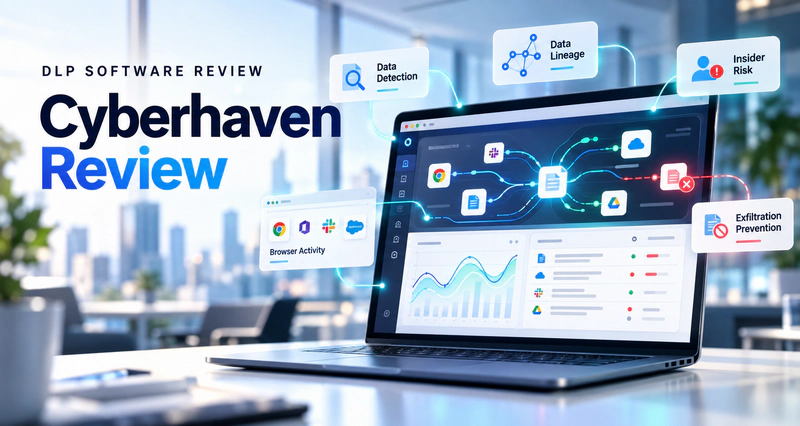
Cyberhaven Review: Quick Verdict
| Question | Short answer |
|---|---|
| What is Cyberhaven best for? | Enterprises that need data lineage, modern DLP, insider risk context, and visibility across endpoint, SaaS, cloud, and AI workflows. |
| Who should compare alternatives? | Organizations requiring a customer-managed on-premises platform, simpler endpoint controls, broader workforce monitoring, or public entry pricing. |
| Is Cyberhaven pricing public? | No standard list price was publicly available at the time of review. Pricing and usage terms are defined through an order form or statement of work. |
| Is it better than traditional DLP? | It can provide richer origin and movement context, but the value must be validated with the organization's own data, applications, endpoints, and policies. |
Cyberhaven has a credible and distinctive approach to modern data protection. Its lineage model is strongest for intellectual property, fragmented data, insider risk, and AI use cases. It's not the right fit for every company—particularly when deployment control, pricing visibility, or employee activity monitoring is the primary driver.
Testing Scenario Results at a Glance
| Scenario | Vendor Claim | Our Finding |
|---|---|---|
| Data lineage across rename, copy, app, cloud, USB | Track all transformations from source to destination | Most consistently validated capability; the primary reason users choose Cyberhaven over legacy DLP |
| USB / removable media detection and blocking | Alert and block sensitive data transfers to USB; support user override with justification | Confirmed: interception described as accurate and reliable, with per-event tracking to support each decision |
| Cloud uploads: personal Dropbox / Google Drive / OneDrive | Block uploads to personal cloud; distinguish personal vs. corporate accounts | Confirmed: account-type distinction is a validated differentiator for organizations where employees use both |
| Email: Gmail and Outlook attachment detection | Control sensitive data in email attachments | Email is the weakest channel. The O365 cloud sensor cannot inspect attachments; endpoint-based Outlook tracking has improved but warrants PoC verification |
| Clipboard / copy-paste detection | Track and block copy-paste events across apps, including paste to unauthorized sites | Cross-application clipboard coverage can vary by application and workflow; evaluate this against the organization's specific environment during a PoC |
| GenAI / ChatGPT: block sensitive data pasted to AI tools | Block confidential data entering AI tools; track AI data flows | Enterprise customers use this for AI governance; vendor telemetry supports the claim |
| Insider risk: departing employee data exfiltration | Real-time detection, alerting, and blocking of departing-employee data theft | A primary deployment driver across accounts |
| Investigation: reconstruct full data history | Lineage provides who/what/when/where/how for investigations | Users report investigation time reduced from hours to minutes |
| Deployment: agent installation and rollout | Fast endpoint agent deployment; production-ready in weeks | Agent installation is quick; full policy stabilization takes weeks to months in enterprise environments |
| Performance: CPU/memory, endpoint stability | Lightweight agent, minimal user impact | Workload-dependent. Data-intensive environments (manufacturing, engineering, large CAD files) see measurable overhead. Knowledge-worker environments will have lighter impact |
What Is Cyberhaven?
Cyberhaven is a unified AI and data security platform. As of 2026, its product portfolio brings together four closely related capabilities:
- Data Loss Prevention: Detecting and controlling sensitive data moving through endpoints, web destinations, email, cloud applications, and removable media.
- Insider Risk Management: Connecting risky behavior with the value and sensitivity of the data involved.
- Data Security Posture Management: Discovering where sensitive data resides, who can access it, and where it is exposed.
- AI Security: Discovering AI applications and agents, monitoring their interaction with sensitive data, and applying real-time controls.
The company's core idea is simple: data security decisions should not rely only on keywords, regular expressions, fingerprints, labels, or destinations. The platform traces the full lifecycle of data. It uses that context to classify information, detect risk, investigate incidents, and enforce policy. The official platform overview positions data lineage as the foundation connecting DLP, insider risk, DSPM, and AI security.
How Cyberhaven works
Cyberhaven collects context from endpoints, browsers, cloud services, SaaS applications, and other connected systems. The platform links these events to build a lineage view. That view shows how data was created, accessed, copied, transformed, and shared.
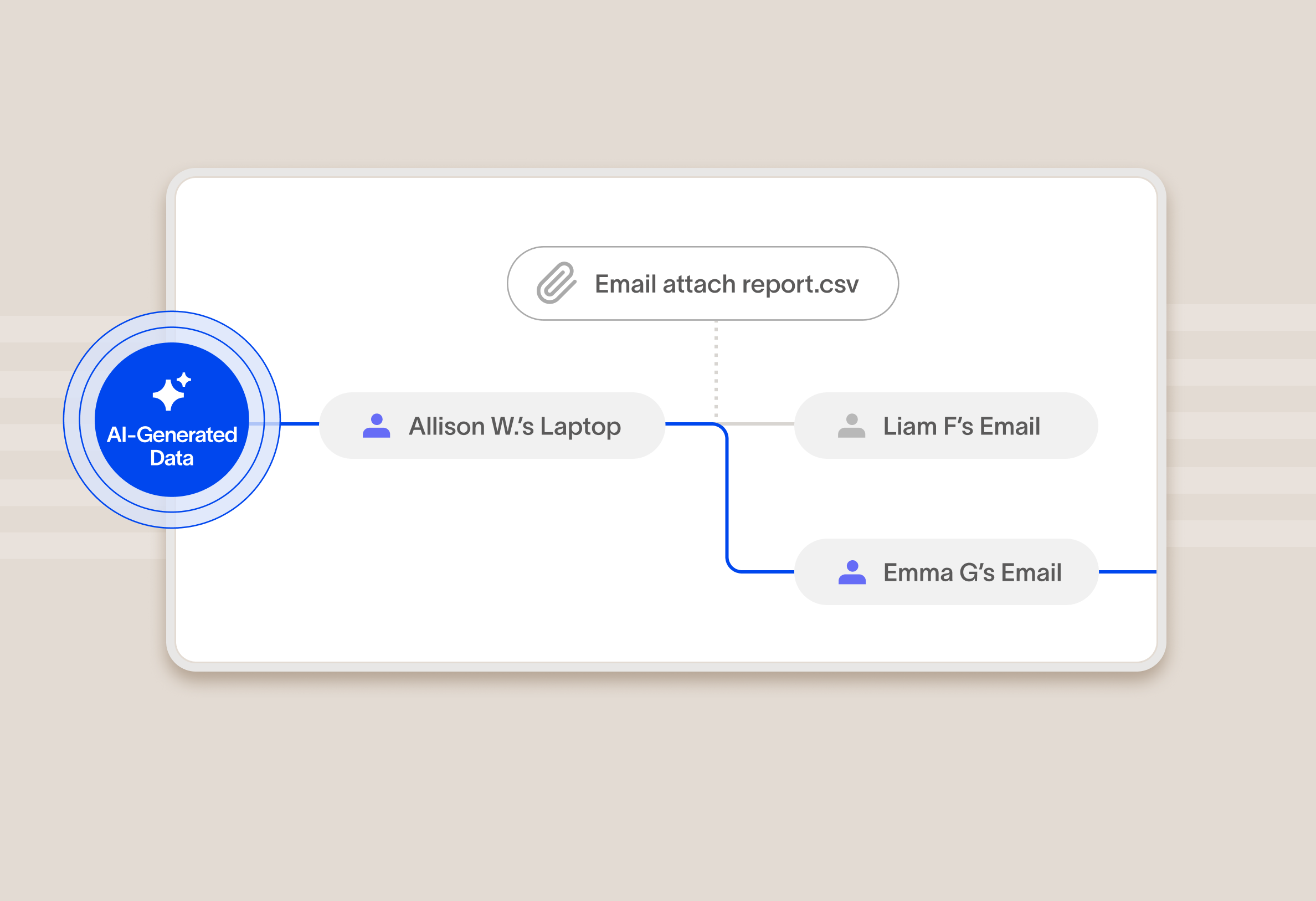
A standard DLP alert tells you a file moved. Cyberhaven is built to tell you more. It shows where the file came from. It shows whether the file was renamed or compressed along the way. It shows whether the destination was a corporate account or a personal one. It also shows whether the user was a person or an AI agent. That context determines whether an event is a real incident or a false positive. Without it, analysts must correlate logs manually.
Cyberhaven Features Review
Data lineage and context-aware classification
Data lineage is Cyberhaven's clearest differentiator. The platform tracks information from its origin through copies, transformations, and destinations. This matters most for intellectual property. Traditional DLP depends on keywords or regex patterns, but IP often doesn't contain them reliably. Source code, product designs, CAD files, and financial models are the obvious examples.
The practical implication is straightforward. An excerpt copied from a confidential design document stays risky even after losing its original file name or label. Cyberhaven's classification considers where the fragment came from, not just what it looks like now.

Cyberhaven delivers its clearest value in IP-heavy environments—source code, CAD files, and design documents—rather than standardized PII records. If regulatory compliance is the primary driver rather than intellectual property, the value proposition is harder to demonstrate clearly.
That said, lineage is only as reliable as the sensors feeding it. Gaps in endpoint coverage, browser support, cloud connectors, or supported applications create blind spots—ones that a vendor-arranged demo with cooperative data is unlikely to surface. A proof of concept should test real business workflows, including the unsupported paths where real incidents tend to occur.
Data lineage was the most consistently validated capability in our testing. From the moment a sensor is installed, visibility into where data moves begins immediately. Lineage proved its value in investigation scenarios—answering "does this file exist on a company device?" dropped from hours of manual work to minutes. Crucially, the combination of lineage and content context triggered investigations that would otherwise not have started: events that looked routine in isolation became significant when their origin was traced. Users described lineage as "exactly what I needed" compared to high-maintenance data-discovery tools.
Endpoint, browser, SaaS, and cloud visibility
The most practically useful part of Cyberhaven's channel coverage is its ability to distinguish personal from corporate cloud accounts. Many employees use both a personal Google Drive and a company-managed one. Most DLP tools cannot tell the difference—so they either block everything or allow everything. Cyberhaven distinguishes between account types in practice. This reduces false positives without loosening policy. That alone is a meaningful advantage over tools that operate only at the domain level.
Email is the exception that matters. The O365 cloud sensor cannot inspect email attachments. Endpoint-based Outlook coverage addresses this at the agent layer. But it requires the agent to be running, and the mail flow must match the tested configuration. For organizations where email is a primary exfiltration channel, this is a significant gap—not a minor caveat. Test your actual mail configuration in a PoC before drawing conclusions from a demo environment.
Clipboard and browser coverage hold up for common workflows. At the edges, they become less reliable. Specific application combinations, complex browser profiles, virtual desktops, and offline endpoints are all edge cases. These are also where real incidents tend to happen. Treat the channel list Cyberhaven publishes as a starting point for evaluation, not a performance guarantee.
One point worth clarifying before the evaluation starts: "visibility into on-premises data" and "an on-premises Cyberhaven management platform" are different requirements. Cyberhaven can discover and monitor data in on-premises environments. But its management and analytics layer is vendor-hosted. Conflating these two things is one of the more common mistakes in DLP evaluations.
USB/removable media: Interception was accurate and reliable in our testing, with built-in per-event tracking that makes each block or allow decision auditable. User-override with justification functioned as documented.
Personal vs. corporate cloud accounts: The ability to distinguish a personal Google Drive or OneDrive from a corporate-managed account is a documented differentiator and was confirmed in testing. For organizations where employees routinely use both account types, this distinction meaningfully reduces false positives while still catching genuine policy violations.
Email attachments (O365): Email was the weakest channel in our evaluation. The O365 cloud sensor cannot inspect email attachments. Endpoint-based Outlook tracking addresses this at the agent layer—Cyberhaven's own engineering blog acknowledged the historical gap and described a fix—but buyers should test their specific email configuration during any PoC.
Insider risk detection and investigation
Cyberhaven's insider risk model addresses a real problem. Behavior-only monitoring generates alerts that don't help analysts decide how seriously to respond. Linking the action to the sensitivity of the data involved changes that. Copying source code is not the same as copying a meeting agenda. When this works, it produces signals worth acting on.
It works best when data classification is already solid. Classification is usually incomplete in the first months of a deployment. When that happens, risk scores reflect classification gaps as much as actual risk.
The platform is not well-suited for discovering what data matters. It is well-suited for prioritizing risk once you already know. Organizations expecting Cyberhaven to solve classification and risk detection at the same time should adjust their timeline.
Where the platform reliably delivers—even when classification is still maturing—is investigation. Reconstructing an incident means finding out what moved, through which applications, to which destination, and who initiated it. Cyberhaven does this without pulling logs from four separate tools. Users describe the time savings as going from hours to minutes.

The screen capture and forensic content features add to this value. But they also create obligations. These include access controls, retention limits, and in some jurisdictions employee notification requirements. Governance decisions on these topics must be made before deployment, not during the first escalation.
Policy enforcement and user coaching
Cyberhaven can move beyond alert-only monitoring. It can warn users, block a risky action, redirect them to an approved destination, or allow an override with a business justification. Done well, this reduces friction between security controls and legitimate work. But the outcome depends entirely on how the policies are built.

The practical challenge in any warning-based system is calibration. Warnings that appear too often become background noise. Override options granted without consequence become meaningless. Blanket blocks generate IT tickets faster than they reduce risk. Test common exceptions before go-live. Give policy owners clear access to review justifications and tune conditions. This addresses failure modes before they reach production.

AI-powered data protection
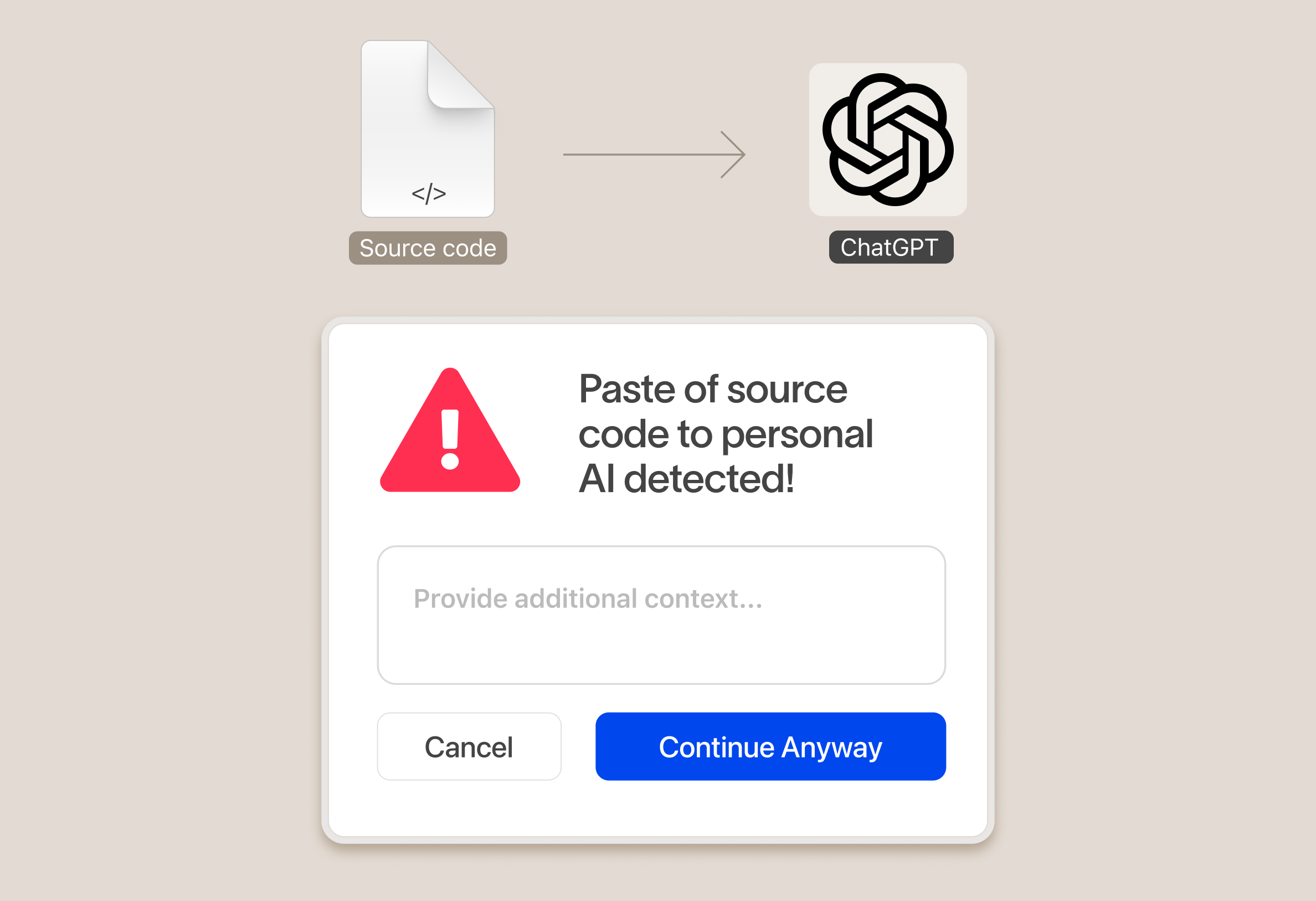
Cyberhaven's approach to AI security is meaningfully different from domain-level blocking. Most tools can prevent an employee from opening ChatGPT. Cyberhaven can tell you that the content pasted into a prompt came from a repository under access control, flagged by two employees last week. If AI governance is a primary requirement, this lineage-based approach is worth evaluating. It addresses the actual risk rather than just the channel.

The honest assessment of coverage is more complicated. Browser-based generative AI tools are the most reliable part: ChatGPT, Claude, and Gemini used in a browser tab represent the mature, validated use case.
Endpoint AI agents, IDE integrations (Copilot, Cursor, Codeium), and MCP server monitoring are newer additions, and their scope varies by operating system, tool version, and general-availability status. The product has expanded quickly in this area—some capabilities that were in preview six months ago are now listed as supported, and some listed as supported today may not yet cover your specific environment or tool version.
If AI security is a core requirement, treat it as a targeted evaluation: identify the AI tools your organization actually uses, test coverage for those specific tools in a PoC, and confirm GA status and licensing in writing. A feature on the roadmap is not a feature you can deploy.
Cyberhaven Pricing: What You Can Confirm Before Getting a Quote
Cyberhaven does not publish a standard price list. There is no reliable public price for a typical deployment. Its 2026 Enterprise Terms give some insight into how direct purchases are structured. Pricing may be based on endpoint users, endpoint usage, or both, as specified in the order form. Unless an order states otherwise, fees are invoiced annually in advance. Usage above contractual limits may result in prorated overage charges.
That gives you a starting point. It does not reveal the full cost of a deployment.
What the public information tells you
Cyberhaven's platform covers multiple areas, including data loss prevention, insider risk, and data security workflows. The public information does not clearly establish how every capability is packaged or whether individual features and integrations are included in a particular license tier.
The same applies to deployment options and integrations. Capabilities such as macOS and Linux support, browser controls, cloud integrations, APIs, and SIEM integrations may be relevant to a deployment, but their inclusion in a specific commercial package is not something public information establishes.
Feature availability and pricing inclusion are two different questions. A capability being supported by the platform does not necessarily mean it is included in the quote you receive.
What to confirm in the quote
For a meaningful cost comparison, ask Cyberhaven to specify:
- License scope: Which products and capabilities are included in the quoted package?
- Pricing unit: Is the quote based on named users, active users, endpoints, servers, browser users, contractors, data volume, or a combination?
- Minimum commitment: Is there a minimum user count or annual contract value?
- Platform and integrations: Are macOS, Linux, browser extensions, cloud connectors, API access, and SIEM integrations included?
- Data retention: What retention period applies to activity records, screenshots, and forensic data?
- Data residency: Do regional hosting or data residency requirements change the price?
- Services: Are implementation, policy design, privacy reviews, endpoint testing, integrations, analytics, training, or technical support included or billed separately?
- Changes in usage: How are overages, additional users at renewal, test environments, and acquisitions handled?
Look beyond the license fee
The license price is only one part of the total cost of ownership. A realistic comparison should also account for implementation, policy tuning, privacy and compliance reviews, endpoint testing, integrations, analyst workload, user training, and ongoing support.
This is particularly important when comparing Cyberhaven with other enterprise security platforms: compare the scope of what is included, not just the headline license price.
AnySecura publishes its plans at $18, $28, and $35 per seat/month billed annually—no sales call required to see entry-level cost. View AnySecura pricing.
Cyberhaven Pros and Cons
| Pros | Cons and buying risks |
|---|---|
| Data lineage connects origin, movement, transformation, and destination context. | No publicly listed standard price makes early budget comparison difficult. |
| Combines DLP, insider risk, DSPM, and AI security in a unified product direction. | A quick sensor rollout does not eliminate policy design and tuning work. |
| Can connect user behavior with the sensitivity of the data involved. | Some reviewers report challenges with complex policies, reporting, API depth, or interface details. |
| Supports real-time actions such as warn, block, redirect, and justified override. | Endpoint compatibility and performance must be tested in the customer's own environment. |
| Addresses modern browser, SaaS, cloud, endpoint, and AI data flows. | Public security information describes a managed GCP service; self-hosted requirements need direct confirmation. |
| Investigation views can reduce manual correlation across disconnected events; incident reconstruction time drops from hours to minutes in tested scenarios. | Screenshots and forensic capture increase privacy, access-control, and retention obligations. |
| Public user feedback frequently recognizes data-flow visibility and vendor support. | Rapid product expansion means you'll need to verify feature availability and platform parity for each capability you're counting on. |
| GenAI channel controls confirmed for AI governance use cases. | Case data retention is limited to 180 days; data beyond that must be exported before it is lost. |
| Event data cross-analysis within the product is limited; SOC teams requiring bulk export or SIEM ingestion report inadequate export capabilities. | |
| Early deployment typically generates a high volume of false-positive alerts; the "90–95% fewer false positives" marketing figure reflects a fully tuned deployment, not an out-of-box state. |
Cyberhaven User Reviews and Feedback
Cyberhaven holds a 4.5/5 on G2 across 18 reviews and approximately 4.6/5 on Gartner Peer Insights in the DLP category. The praise and the complaints are consistent across both platforms, regardless of deployment type or team size.
What users value
Positive themes that appear consistently across both platforms:
- Clear visualization of data movement and lifecycle
- Faster DLP review and exfiltration investigation
- Visibility soon after endpoint sensor deployment
- Source-based classification and support for IP-related use cases
- Responsive vendor support
- A relatively lightweight endpoint experience in some environments
The lineage model produces its clearest value in IP-heavy environments. Tracing where a CAD file or code repository traveled—and who touched it—changes how risk is assessed. The question shifts from cataloguing events to understanding whether a specific asset left the organization and by what path. That is a different kind of evidence from a content-match alert. Reviewers who needed it found it compelling.
What users want improved
Recurring concerns across both platforms:
- Creating complex custom policies is not always straightforward.
- Large environments still require focused tuning.
- Users have requested richer webhooks, APIs, and report-export options.
- Some interface elements, including lineage visualization and zooming, take time to learn.
- One detailed negative G2 review documented login problems, application disruption, and degraded endpoint performance.
Login delays, application disruption, and performance degradation are predictable failure modes. They occur when an endpoint agent conflicts with the existing environment. A compatibility test on a representative set of machines surfaces these issues before rollout. They are significantly harder to remediate once deployed at scale.
Cyberhaven vs Traditional DLP
| Category | Traditional DLP approach | Cyberhaven approach | What buyers should test |
|---|---|---|---|
| Data identification | Patterns, exact match, fingerprints, labels, file type | Content plus origin, context, behavior, and lineage | Classification of IP, fragments, renamed files, and copied text |
| Event context | Often evaluates a transfer or policy match in isolation | Connects events across users, applications, time, and destinations | Whether lineage remains intact through actual business workflows |
| Insider risk | DLP events and user behavior may be managed separately | Combines behavior with the sensitivity of affected data | Risk prioritization and false-positive reduction |
| Investigation | Analysts correlate logs from several tools | Lineage, activity, and evidence are presented together | Time to reach a defensible conclusion |
| Enforcement | Alert, quarantine, or block based on policy match | Warn, block, redirect, redact, justify, or escalate by context | Business exceptions and override governance |
| AI workflows | Often limited to domains, network traffic, or prompt inspection | Extends visibility toward browser, endpoint, IDE, agents, and MCP | GA status, supported tools, local-agent visibility, and response depth |
Cyberhaven is most compelling when an organization already has DLP rules but analysts keep hitting dead ends. The alert shows that data moved. It does not explain where the data came from or whether the destination matters. That is the specific gap lineage is designed to fill.
Traditional DLP stays the right call when the requirement is narrow, the data is well labeled, and the environment is stable. It is also the right call when existing controls already cover the highest-risk channels. Do not replace a working system because a vendor called it "legacy." Replace it because you have measured the detection gap and the cost of switching makes sense.
Cyberhaven Deployment, Privacy, and Security Questions
Deployment experience: what our testing found
The deployment pattern is consistent: quick to install, slow to tune. Agent installation and initial data visibility are genuinely fast. In one reported account, data movement was visible from the moment the sensor was installed. Adding a DSPM module was described as "flipping a switch." The challenge comes after installation.
Reaching an operational state—where alerts are actionable and false positives are controlled—requires sustained iteration. Users described rollout as "long and arduous" with significant tuning effort. Initial alert volumes can be high. Alert fatigue is a documented early-phase risk.
| Factor | Faster / Easier | Slower / More Complex |
|---|---|---|
| Organization size | Small organization or limited PoC | Large enterprise environment |
| Scope | Adding DSPM to an existing deployment | Full new deployment of DLP + IRM + DSPM |
| Policy complexity | Monitor-only mode; observe before configuring | Blocking policies enabled from day one |
| Organizational maturity | Data flows understood before deployment | Using Cyberhaven to discover data flows for the first time |
| Support model | Vendor CSM-guided PoC | Self-directed implementation |
The practical implication is clear. Budget time and analyst resources for policy tuning, not just sensor rollout. The sensor is the beginning of deployment, not the end.
Performance impact: what our testing found
Endpoint performance impact is workload-dependent. It is not uniformly experienced. In data-intensive environments—manufacturing with large CAD files, engineering with high file I/O volumes—users reported login delays, reduced application responsiveness, and noticeable slowdowns even on new hardware. In knowledge-worker environments, impact was described as minimal.
Cyberhaven's own engineering documentation acknowledges deep integration with operating system calls. It sets an internal design target of 800MB of memory per agent. The company has declined to publish average CPU percentages. It cites the misleading nature of averages across workload types. A representative performance test covering the actual endpoint population—not a clean reference machine—is a prerequisite, not an option.
Cyberhaven's public security policy states that its SaaS products run in GCP data centers in the United States. SaaS customer data is stored in North America by default. Other GCP-supported regions are available on request. Each customer operates in an isolated environment.
One distinction is worth clarifying. This does not mean Cyberhaven cannot discover or protect data in on-premises systems. It means the management and analytics platform is vendor-hosted. These are separate requirements. Organizations that need a fully customer-hosted server and database should get a written answer directly from Cyberhaven during procurement. Do not infer an answer from product documentation alone.
The 2024 Chrome extension incident
In December 2024, an attacker used a phishing and malicious OAuth-consent flow to compromise access associated with Cyberhaven's Chrome Web Store publishing process. A malicious extension version, 24.10.4, was distributed to a portion of the customer base before removal. Cyberhaven confirmed the incident, and the Cyber Security Agency of Singapore later referenced it as part of a broader campaign targeting browser extensions.
The incident does not establish the current product as broadly unsafe. Public reporting did not quantify actual credential theft across all affected installations. The malicious version was removed promptly. It does justify a specific set of procurement questions: release approvals, signing and publishing permissions, extension-update controls, detection capabilities, customer notification procedures, rollback options, and what process improvements Cyberhaven made after the event. These are reasonable questions for any buyer to raise.
Cyberhaven Alternatives
The best Cyberhaven alternative depends on why the product is being reconsidered. A company that needs a private deployment has a different shortlist from one that needs Microsoft-native DLP or intensive employee activity investigation.
Commonly evaluated Cyberhaven competitors include Microsoft Purview, Forcepoint DLP, Proofpoint, Symantec DLP, Endpoint Protector, Teramind, and newer endpoint-focused platforms such as AnySecura. These products are not interchangeable. Build your shortlist around deployment requirements and use case, not brand popularity.
| Alternative | Best suited for | Key difference from Cyberhaven | Pricing visibility |
|---|---|---|---|
| AnySecura | On-premises/private deployment, endpoint DLP, employee activity visibility, and document encryption | Broader endpoint monitoring and privately managed architecture; not positioned around the same lineage-first model | Public plans start at $18/seat/month billed annually; verify scope and current terms |
| Microsoft Purview DLP | Microsoft 365 and Azure-centered organizations | Deep integration with Microsoft labels, workloads, endpoints, compliance, and licensing | Public Microsoft 365 and Purview licensing, but packaging is complex |
| Forcepoint DLP | Large regulated enterprises needing mature channel coverage and hybrid/on-premises options | Established enterprise DLP with SaaS, on-premises, and hybrid deployment | Quote-based |
| Proofpoint Insider Threat Management | People-centric insider risk and privacy-aware investigations | Strong user activity timeline, optional visual evidence, privacy controls, and Proofpoint ecosystem context | Quote-based |
| Symantec DLP | Mature DLP teams with complex endpoint, network, storage, email, and cloud requirements | Broad legacy-enterprise coverage and flexible deployment | Quote-based |
| Endpoint Protector | Multi-OS endpoint DLP, USB/device control, and focused content-aware protection | More narrowly focused on endpoint and removable-media control | Quote-based |
| Teramind | Detailed employee monitoring, user activity analytics, and forensic investigation | Employee monitoring and workforce activity are more central to the product | Plan-based licensing; DLP/enterprise details may require sales |
Cyberhaven vs Microsoft Purview
Cyberhaven is likely to be more compelling when cross-application data lineage and modern endpoint, SaaS, and AI data movement are the priority. Microsoft Purview may be more economical and operationally convenient when the organization already licenses Microsoft 365 E5. It is also a better fit when most sensitive data lives in Exchange, SharePoint, OneDrive, Teams, Windows, and connected Microsoft services.
Microsoft's Endpoint DLP documentation covers Windows and recent macOS versions. Purview's DLP capabilities are packaged within Microsoft 365 and compliance licensing bundles. This can make it hard to confirm which features are included in an existing license before engaging sales. The PoC should compare actual coverage outside Microsoft workloads, policy administration, classification accuracy, incident context, and the incremental cost of features not already covered by current Microsoft licensing.
Cyberhaven vs Forcepoint, Proofpoint, and Symantec
Forcepoint and Symantec have established enterprise DLP coverage across endpoint, network, cloud, storage, and email channels. This suits large regulated organizations with complex, multi-channel requirements. Implementation and policy administration tend to be time-intensive. Factor that into any total-cost comparison. Proofpoint is a particularly relevant Cyberhaven competitor when people-centric insider risk, endpoint evidence, and privacy controls are central.
Cyberhaven's argument against these platforms is not that established DLP is worthless. It is that lineage gives analysts a clearer picture of modern data movement with less manual log correlation. Run that comparison yourself. Use the same data set and the same incident scenarios across each shortlisted product. Do not take a vendor's word for it.
Cyberhaven vs AnySecura
Cyberhaven and AnySecura overlap in DLP, insider risk, endpoint visibility, policy enforcement, and investigation. The main difference is emphasis. Cyberhaven centers on data lineage and data movement across endpoints, cloud applications, and AI workflows. AnySecura combines endpoint activity monitoring, DLP, insider risk controls, and document protection in a customer-managed deployment.
| Category | Cyberhaven | AnySecura |
|---|---|---|
| Primary positioning | Data lineage, DLP, insider risk, DSPM, and AI security | Endpoint DLP, employee activity monitoring, insider risk, and document security |
| Visibility | Data origin, movement, transformation, users, applications, and destinations | Applications, websites, files, screens, email, IM, printing, network, and removable media |
| Deployment | Managed GCP-based SaaS | Customer-managed server, database, console, and endpoint agents |
| Employee activity | Primarily data-risk and security-event focused | Broader endpoint and screen activity visibility |
| Document protection | Context-aware DLP and real-time controls | Content inspection, classification, watermarking, transparent encryption, and transfer controls |
| AI security | Strong focus on shadow AI, agents, IDE/CLI, MCP, and data lineage | Endpoint-focused controls for AI-related data movement |
| Pricing | No public standard price list | Public plans from $18/seat/month, billed annually |
Where the difference matters
Data visibility. Cyberhaven traces the journey of the data—origin, movement, transformation, and destination. AnySecura captures the activity surrounding the data: applications used, websites visited, files accessed, screens, print jobs, removable media transfers, and communications including email and instant messaging. For high-risk events such as copying files to removable media or deleting sensitive documents, AnySecura automatically captures a screenshot at the moment of the action.
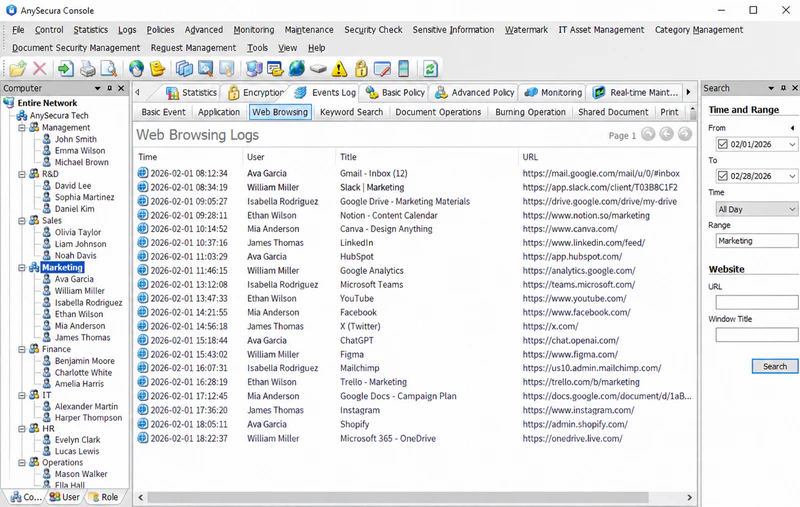
Email channel. Cyberhaven's email visibility is limited compared to its endpoint and cloud coverage. AnySecura audits the full email lifecycle—body text, attachments, sender, recipient, and timestamp—across standard, web-based, Exchange, and Lotus clients. Outbound control goes beyond logging. Administrators can restrict sending permissions by employee, enforce mandatory CC rules, and filter by recipient, subject, attachment name, or file size. Emails containing sensitive content are automatically intercepted before they leave the endpoint.
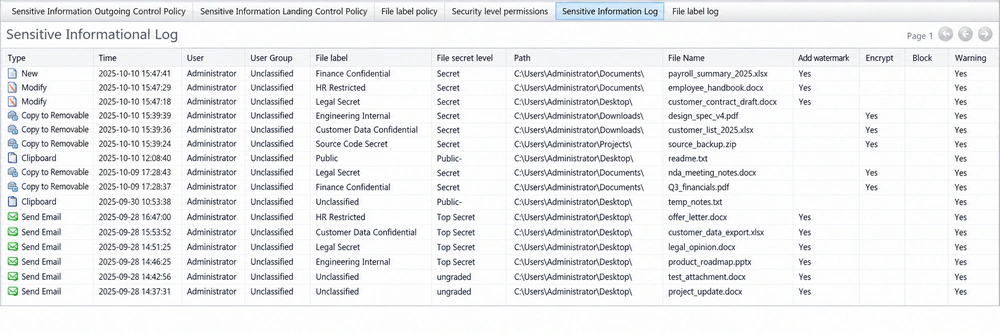
Document protection. AnySecura applies transparent encryption at three levels: mandatory (files open only on authorized devices), optional (encrypted and unencrypted files coexist without workflow friction), and read-only (viewing is permitted, but copying, printing, and screenshots are blocked). Sensitive documents are automatically backed up before high-risk actions such as copying, modification, or deletion. This preserves the original for investigation even if the file is later changed or removed. Watermarks apply automatically during external sharing, decryption, printing, and local storage. They remain traceable after a document leaves the organization.
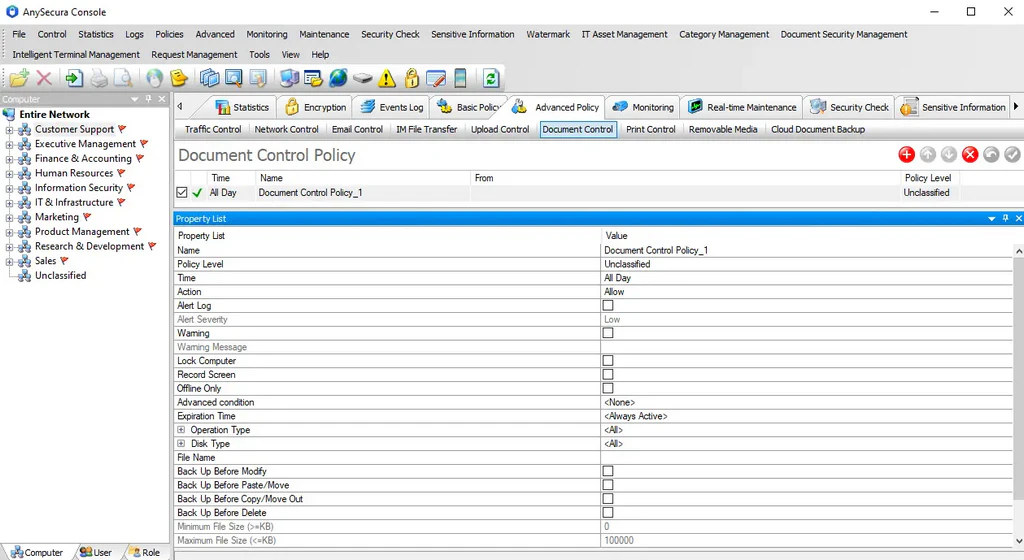
Deployment. Cyberhaven runs on a managed GCP-based cloud. AnySecura deploys entirely within the customer's environment. The server, database, management console, and endpoint agents are all customer-controlled. For organizations with data-residency requirements, air-gapped networks, or vendor-risk policies that prohibit third-party data access, this is an architectural requirement, not a preference.
Which one fits?
Cyberhaven puts more emphasis on data lineage across cloud, endpoint, and AI workflows. AnySecura puts more emphasis on endpoint activity visibility, document protection, and customer-controlled deployment.
The right choice depends on the organization's deployment model, investigation needs, and the level of endpoint and document control required.
AnySecura runs entirely in your environment—no vendor-hosted cloud required. Try it free or request a demo matched to your deployment requirements.
Is Cyberhaven Right for Your Business?
When Cyberhaven is a good choice
Consider Cyberhaven when:
- Your current DLP identifies events but cannot explain the data's origin or journey.
- Intellectual property and unstructured data are more important than standardized PII patterns.
- Data moves frequently between endpoints, SaaS, cloud, code tools, personal accounts, and AI applications.
- Insider risk investigations require both behavior and data sensitivity.
- You have a security team capable of running a structured rollout and ongoing policy program.
- The SaaS architecture, regional hosting options, and evidence controls pass your privacy and vendor-risk reviews.
When businesses may consider alternatives like AnySecura
Compare alternatives when:
- A customer-controlled on-premises or private deployment is mandatory.
- Employee activity monitoring, screen history, application use, web activity, and detailed endpoint logs are primary requirements.
- You need document labeling, watermarking, transparent encryption, USB/device control, and DLP in one endpoint platform.
- Your organization already has Microsoft 365 E5 and mainly needs Microsoft-native coverage.
- You need public entry pricing or a smaller, more focused endpoint DLP solution.
- If cross-SaaS and AI data lineage is the core requirement, Cyberhaven warrants a pilot.
- If private deployment, endpoint activity history, and transparent pricing matter most, evaluate AnySecura alongside it.
- If your stack is already Microsoft 365 E5, start with Purview before adding a third-party layer.
FAQs about Cyberhaven
What is Cyberhaven used for?
Cyberhaven is used to discover, classify, monitor, and protect sensitive data across endpoints, browsers, SaaS applications, cloud environments, and AI workflows. It also supports insider risk detection and investigation.
Is Cyberhaven a DLP solution?
Yes. Cyberhaven provides data loss prevention, but its current positioning extends beyond DLP to insider risk management, DSPM, and AI security.
What is Cyberhaven data lineage?
Data lineage connects a piece of information with its origin, transformations, users, applications, and destinations. Cyberhaven uses that context to improve classification, investigations, and policy decisions.
Does Cyberhaven publish its pricing?
No standard Cyberhaven pricing list was publicly available at the time of this review. Enterprise terms indicate that fees may depend on endpoint users or usage and are defined in an order form or statement of work.
Is Cyberhaven available on-premises?
Cyberhaven can provide visibility into data in on-premises environments, but its public security policy describes a GCP-hosted SaaS platform. Organizations requiring a fully customer-hosted management plane should confirm availability and architecture directly with Cyberhaven.
Does Cyberhaven monitor employee activity?
Cyberhaven collects user behavior related to data risk and insider-threat investigations. Public documentation also describes optional screenshots and forensic content capture. It is primarily a data security platform, not a general workforce productivity tracker.
Does Cyberhaven support AI tools?
Cyberhaven publicly documents discovery and control for generative AI applications, endpoint agents, coding assistants, and MCP servers. Buyers should confirm supported tools, operating systems, licensing, and general-availability status.
What are the main Cyberhaven limitations?
Based on testing and user feedback, key limitations include: a 180-day default case data retention ceiling (data must be exported proactively), limited event data export and cross-analysis capabilities (relevant to SOC and SIEM integration), high initial false-positive volumes that require active tuning before alerts are actionable, O365 email attachment gaps via cloud sensor, and endpoint performance overhead in data-intensive environments such as manufacturing or engineering. Purchasing concerns also include the lack of public list pricing and the need to verify new AI features individually.
What are the best Cyberhaven alternatives?
Leading alternatives depend on the use case. AnySecura fits private deployment and endpoint monitoring requirements; Microsoft Purview fits Microsoft-centered environments; Forcepoint and Symantec fit broad enterprise DLP; Proofpoint fits people-centric insider risk; Endpoint Protector fits multi-OS endpoint and device control; and Teramind fits detailed employee activity monitoring.
Is Cyberhaven better than traditional DLP?
Cyberhaven can provide richer context through data lineage, especially for intellectual property and fragmented data. Whether it is better depends on classification accuracy, coverage, false positives, operational workload, deployment constraints, and cost in the buyer's own environment.
Conclusion
Cyberhaven is a credible choice when data lineage across endpoints, SaaS, cloud, and AI workflows is the core requirement. The limitations are real—opaque pricing, policy tuning workload, email channel gaps, and performance overhead in data-intensive environments—but none disqualify the product if the evaluation is done properly.
Organizations that need a privately managed deployment, transparent pricing, broad endpoint activity evidence, or document protection alongside DLP should evaluate AnySecura. Try it free or request a demo tailored to your deployment requirements.