
If you've heard that forensic watermarking "protects content," that's only half the story. It doesn't stop a leak from happening. What it does is identify exactly who leaked what, after the fact, by embedding a unique, invisible identifier into every distributed copy of your content.
This article explains how forensic watermarking works at a technical level, where it's deployed (across streaming platforms, film production, and enterprise document distribution), how it relates to DRM and DLP tools you may already have, and what its real limitations are.
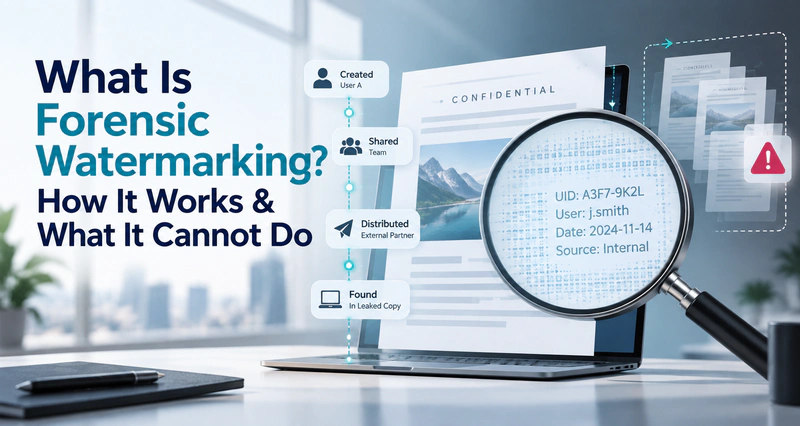
The Core Idea of Forensic Watermarking: Attribution, Not Prevention
Forensic watermarking is a specialized application of digital watermarking. When content is distributed, whether a video stream, a PDF, or a confidential document, each recipient receives their own uniquely marked copy. The mark is imperceptible: viewers, readers, and listeners cannot detect it under normal conditions. It operates below the threshold of human perception, embedded at a signal level within the content itself.
The mark ties that specific copy to the specific recipient, session, or device that received it. If that copy later surfaces on a piracy site, in a news article quoting a confidential document, or in a competitor's hands, it can be submitted for analysis. The identifier is extracted, cross-referenced against a distribution database, and the source of the leak is identified.
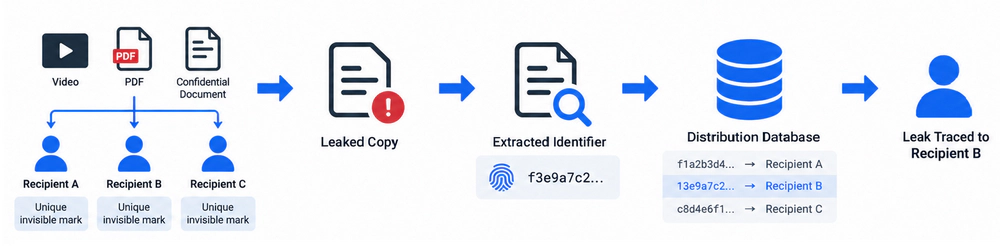
The primary value of this technology is attribution: establishing which copy was the source and, from that, which recipient distributed it. The secondary value is deterrence: recipients who know their copy is uniquely traceable are less likely to leak it. The psychological effect of traceability is real, even when the mark itself is invisible. However, forensic watermarking can't prevent a leak.
How Forensic Watermarking Works
Step 1: Embedding the Identifier
Embedding happens at one of three points in the delivery chain: before transcoding (at encoding time), at the CDN edge during delivery, or client-side during rendering or playback. During the content distribution process, a unique identifier is embedded into the content. The identifier typically encodes information such as the recipient's ID, session ID, device ID, distribution timestamp, or distribution channel, whatever is needed to connect a specific copy to a specific distribution event.
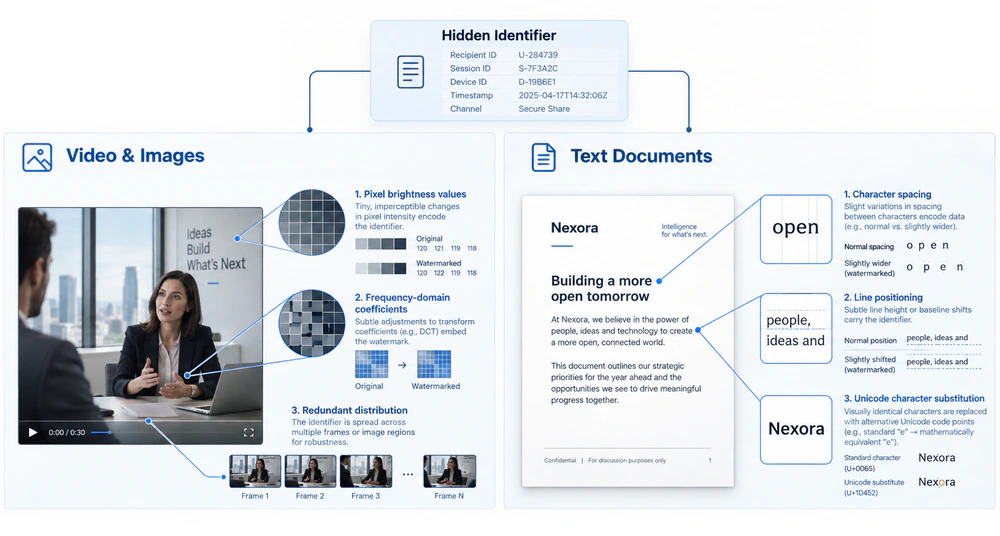
For video and images, embedding is accomplished through imperceptible modifications to pixel brightness values or to frequency-domain coefficients. Human vision cannot detect these changes, but purpose-built extraction software can. The mark is distributed redundantly throughout the content, not confined to a single frame or section, so that a partial or degraded copy still retains enough signal for extraction.
For text-based documents, the watermark is hidden through subtle typographic manipulation, including tiny shifts in character spacing, line positioning, and Unicode character substitution — changes imperceptible in normal reading but recoverable through analysis.
Step 2: Distribution: One Unique Copy per Recipient
Once marked, each recipient receives their own copy. Recipient A's copy carries A's identifier; Recipient B's copy carries B's. The identifier-to-recipient mapping is stored in an external database, not inside the file. The content carries only the encoded signal.
It means the file cannot be reverse-engineered to reveal the distribution list — the identifier alone is meaningless without the database to resolve it. It also means the database becomes an authoritative chain-of-custody record: it shows who received which copy, when, and through which channel.
Step 3: Detection After a Leak
When a suspected leaked copy surfaces, it is submitted to a forensic extraction tool. Well-designed systems support what is called blind detection: the watermark can be extracted without access to the original clean file. There is no need for a "before" version to run a comparison.
Step 4: Attribution: From Identifier to Source
The extracted identifier is cross-referenced against the distribution database. The result identifies the specific recipient whose copy matches, the confidence score for that attribution, and the timestamp of the relevant distribution event. This output becomes the basis for whatever investigative or legal response follows.
A/B Watermarking: How Video Streaming Handles Scale
In video streaming, embedding a unique watermark into every viewer's copy at delivery time would be computationally impractical at scale — unique encoding per viewer, per session, across millions of concurrent streams is not feasible.
The industry solved this with A/B watermarking. For each video segment, two slightly different pre-encoded variants are prepared — call them A and B. Each viewer receives a unique sequence of these variants, assembled in real time during delivery: for example, AABABBA... This sequence is unique to each viewer and encodes their identity as a binary pattern. When a pirated recording surfaces, the A/B sequence embedded in the footage is extracted and matched to the specific viewer whose session used that combination.
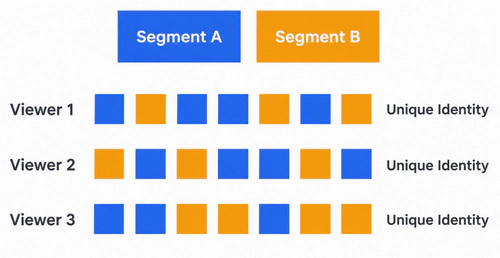
With only two variants per segment, a platform can give 80,000 concurrent viewers unique session watermarks without producing 80,000 separate encodes.
Visible vs. Invisible Watermarks: Two Different Jobs
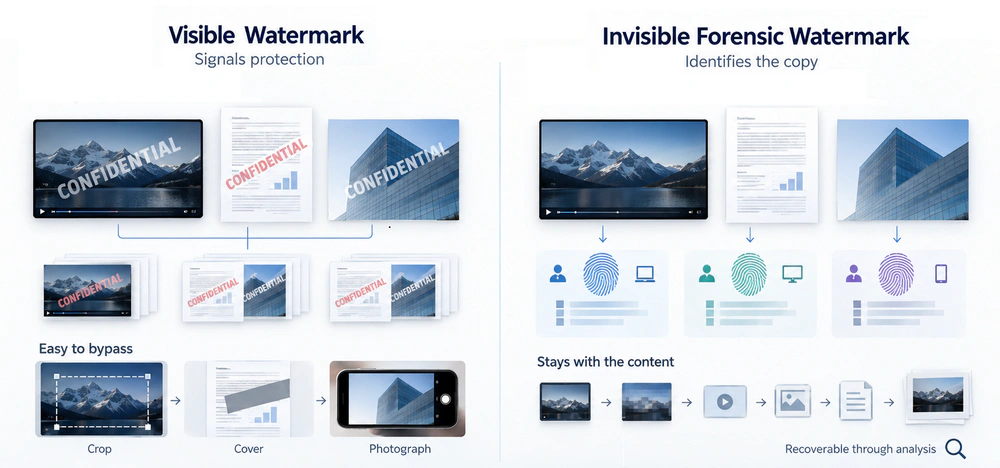
When most people imagine a watermark, they picture the visible kind: a "Confidential" text overlay on a document, a "For Screener Use Only" banner burned into a video frame, or a company logo stamped across an image. These serve legitimate purposes — asserting ownership, signaling sensitivity, and creating psychological deterrence — but they are not forensic watermarks in any useful sense.
A visible watermark is typically the same mark on all copies, or varies only in obvious ways such as a recipient's printed name at a fixed position. That means it can establish that a document belongs to a certain category, but it cannot tell you which specific copy leaked when all copies look essentially the same. And it can be defeated by anyone willing to crop the overlay, cover it with paper, photograph the screen from an angle that excludes it, or simply print without the banner.
Invisible forensic watermarks operate at an entirely different level. Embedded below the threshold of human perception, they cannot be detected visually, cannot be cropped away, and survive re-encoding, compression, format conversion, and printing. The only practical way to remove them is to damage the content itself.
Forensic Watermarking, DRM, and DLP: What Each Does
The three technologies address different failure modes, which is why they are complementary rather than alternatives. Understanding what each one does, and specifically where it stops working, is the fastest path to understanding why forensic watermarking exists.
DRM: Preventing Unauthorized Access (But Not Everything)
BuyDRM, a video DRM and watermarking provider, describes the relationship this way: DRM is the front-door lock; forensic watermarking is the hidden security camera inside the house.
Digital rights management (DRM) encrypts content and enforces license conditions. It controls who can decrypt and play or open a file. The security it provides is real: an external attacker without a valid license cannot access the content at all.
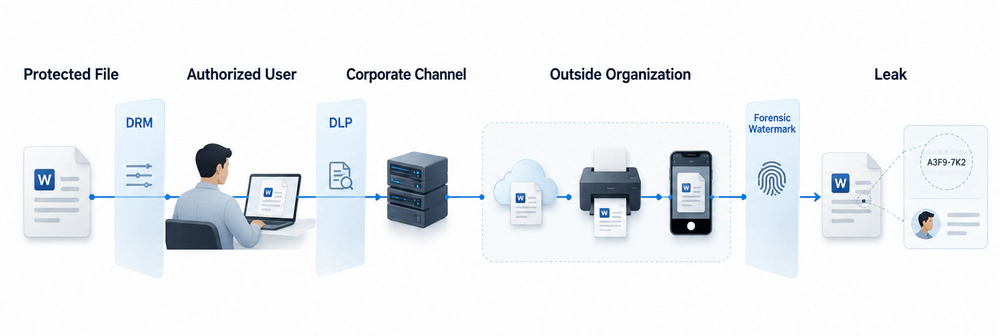
That said, an authorized employee who has access to a confidential document can print it on a personal printer, photograph it on a personal device, or share selected content with someone outside the organization, none of these actions violate the license check that DRM is designed to enforce.
DLP: Blocking Data Movement Through Monitored Channels (But Not Off-Channel)
Data loss prevention (DLP) monitors network traffic, email, endpoints, and cloud storage. It can block a sensitive file from leaving through a corporate email system, prevent uploading to unauthorized cloud services, or alert when confidential data moves outside a defined perimeter.
The gap in DLP's coverage is the channel it cannot see. A print job sent to a personal printer at home bypasses corporate network monitoring entirely. A photograph of a document taken on a personal phone creates no data movement that a DLP tool can detect. The leak has occurred through channels that are, by design, outside the DLP perimeter.
What is a malicious insider? Learn how to identify different types, spot warning signs, and use effective strategies to protect your organization's data and systems.Learn more>>
Why These Tools Work Together
DRM, DLP, and forensic watermarking each cover a distinct failure mode — which is why the question for most organizations is rarely which one to choose, but which combination fits the threat model.
DRM blocks external technical bypass — it works against attackers who lack legitimate credentials. DLP catches careless or opportunistic data movement through monitored corporate channels — it stops employees from forwarding files via corporate email or uploading to unauthorized services from managed devices. Forensic watermarking covers what remains: authorized insiders who bypass DRM with legitimate access, and leaks through channels DLP cannot see — personal printers, personal devices, personal cloud accounts, analog capture.
| Technology | Primary Role | What It Covers | Key Limitation |
|---|---|---|---|
| DRM | Control access and playback | Unauthorized users and devices without a valid license | Cannot identify an authorized user who records or shares content |
| DLP | Monitor and block sensitive data movement | Email, endpoints, cloud services, networks, and other monitored channels | Cannot see off-channel leaks such as personal photos or unmanaged printing |
| Forensic Watermarking | Trace a leaked copy to its distribution source | Authorized recipients, sessions, devices, or partner copies | Provides attribution after a leak rather than preventing the leak itself |
Where Forensic Watermarking Is Used
Forensic watermarking appears wherever high-value content flows to multiple named recipients and post-leak attribution needs to remain possible. The technology spans two largely separate markets — video and media on one side, enterprise documents on the other — which share the underlying principle but have distinct technical implementations and vendor ecosystems.
Video Streaming and OTT Anti-Piracy
Premium video presents a specific problem. DRM prevents most external technical bypasses, but once video is rendered on an authorized subscriber's display, it exists as clear video that can be screen-recorded. A subscriber's camera pointed at a television captures real content regardless of what the DRM license says.
Forensic watermarking embeds a subscriber-specific or session-specific identifier into the stream before delivery. A screen recording retains the identifier. When a pirated stream appears on a piracy site, submitting the video for extraction returns the specific subscriber account or distribution partner whose copy originated the pirated version — typically within minutes. The account is terminated, evidence is preserved, and takedown requests can be issued with a specific evidentiary basis.
Pre-Release Screeners: Film and TV
Studios distribute "for your consideration" screeners to award voters, critics, and festival jurors before theatrical release. A screener leak before theatrical release can significantly affect box office revenue and franchise value. Each screener is distributed to a named individual with a unique identifier embedded at distribution. When a screener appears online, the studio identifies which voter or partner's copy was the source.
Enterprise Documents — M&A, Finance, Government, Pharma
Sensitive documents distributed to employees, external advisors, or regulated parties represent a growing use case. A confidential acquisition analysis is distributed to eight advisors, each receiving a uniquely watermarked copy. Three days before the expected announcement, the document's contents appear in a financial news article. The journalist's source forwarded or photographed their copy. Watermark extraction from the leaked artifact identifies which advisor's distribution event was involved.
This use case spans financial services (M&A documents, earnings releases, investment memos), pharmaceutical and biotech companies (clinical trial data, IP documentation), law firms, government agencies, and academic research.
B2B Content and Partner Distribution
Forensic watermarking can also be used when valuable content is licensed or supplied to distributors, resellers, franchisees, and other business partners. Instead of identifying an individual employee, the watermark links each copy to a particular partner or account. If the material appears outside its permitted channels, the mark may help identify the partner associated with that copy and support an investigation into unauthorized redistribution or a possible contract violation.
What Forensic Watermarking Solutions Are Available
The market divides into two distinct categories, with limited overlap between them. Video and media vendors build for streaming infrastructure, OTT platforms, and professional production workflows. Enterprise document vendors integrate with endpoint management, document control, and DLP systems. The right starting point for any evaluation is your content type.
Video and Media Forensic Watermarking
| Vendor | Product | Main Use | Notes |
|---|---|---|---|
| NAGRA | NexGuard | OTT anti-piracy, screeners, games | DASH-IF/ETSI compliant; Hollywood-approved for pre-release screeners |
| Irdeto | TraceMark | Live streaming, VOD | Production-grade; strong technical depth in collusion resistance |
| Verimatrix | Streamkeeper | Live/linear/VOD, sports | Client + server-side options |
| Synamedia | ContentArmor | OTT, live sports | Hollywood studio-approved for screeners |
| DoveRunner / PallyCon | PallyCon | OTT, e-learning | Mid-market option |
Enterprise Document and Email Forensic Watermarking
| Vendor | Product | Main Use | Notes |
|---|---|---|---|
| EchoMark | EchoMark | Email + documents, insider threat | Explicitly discloses steganographic techniques; AI text rephrasing per recipient |
| SealPath | SealPath IRM | Enterprise document security | Dynamic visible watermarks integrated with IRM |
| Fasoo | Fasoo Enterprise DRM | Documents, insider deterrence | DRM + visible screen watermark combination |
| AnySecura | Watermarking & Document Tracing | Enterprise DLP + watermarking | Visible watermarks (screen, print, document) + invisible document watermark + Circulation Traceability + complete investigation workflow |
| Digify | Digify | Data rooms, M&A | Deterrence-focused; audit trails and access logging |
AnySecura: Integrated Document Watermarking and Traceability
AnySecura is designed for enterprise document tracing. Its Watermarking & Document Tracing capabilities combine several layers: visible watermarks for screens, printed output, and documents; an invisible Implicit General Document watermark for electronic documents; an invisible numeric watermark for image files; and Circulation Traceability, which can add traceable information whenever a file moves through a controlled channel. Administrators can configure watermark content such as the user, computer, IP address, date, time, or document number through reusable templates.
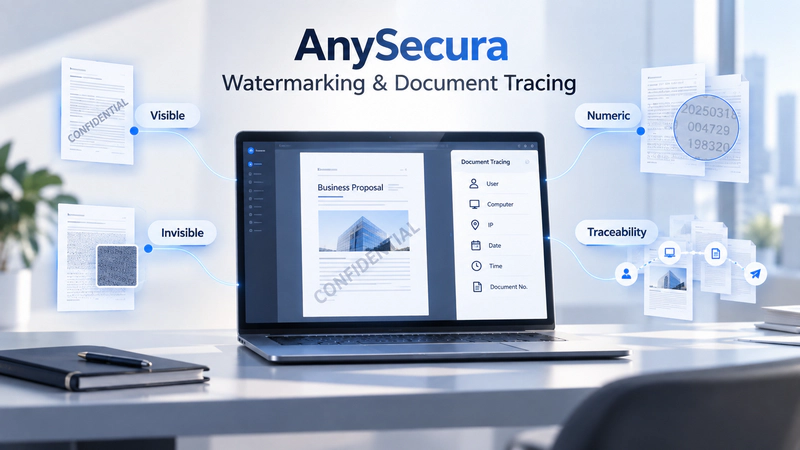
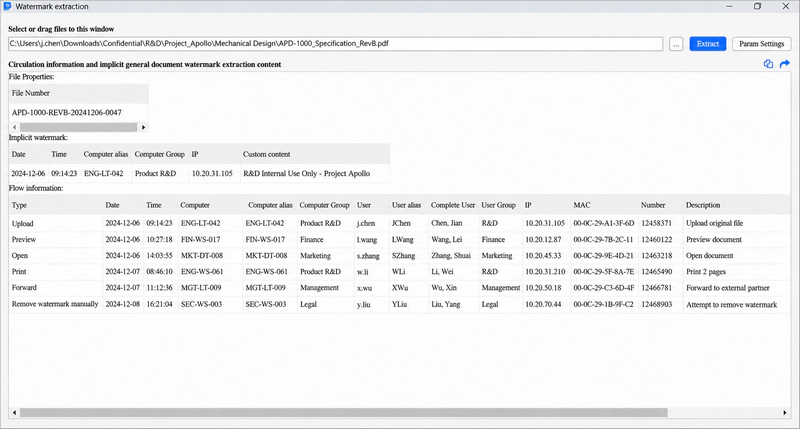
Watermarking can be triggered when a file is copied to removable media or a network drive, transferred through supported messaging tools, attached to an email, uploaded through a browser, decrypted, or created or modified locally. Channel-specific controls depend on the corresponding AnySecura modules being deployed. Circulation records can retain both the current and previous traceability information, helping investigators reconstruct how a document moved before it was leaked.
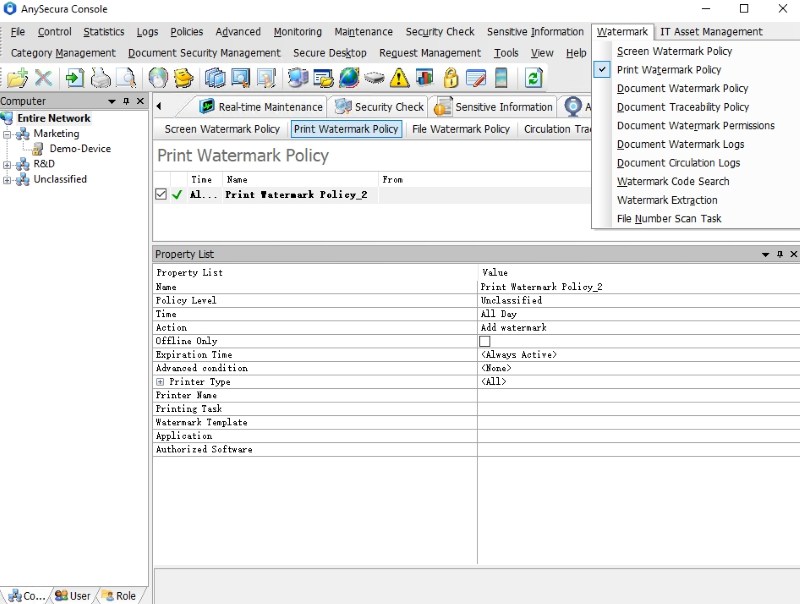
After a suspected leak, the Document Watermark Extraction Tool can recover the document ID, implicit watermark, and circulation information from the file. Administrators can then use Watermark Code Query, Document Watermark Logs, and the Document Circulation Log to connect the extracted data with the relevant user, computer, operation, source and destination paths, and distribution history. This makes AnySecura an integrated option for organizations that want DLP controls and post-leak document tracing in the same platform.
What Limitations to Know Before You Deploy
Forensic watermarking is a strong attribution instrument. It is not a foolproof security control, and evaluating it honestly means understanding its specific boundaries.
It does not prevent leaks. This is worth restating even here: forensic watermarking deters (psychologically, through the awareness of traceability) and attributes (forensically, after a leak occurs). A determined leaker who accepts the risk of identification cannot be stopped. Organizations should plan for this — watermarking is evidence infrastructure, not access control.
Sophisticated attackers can attempt removal, with varying success. Wikipedia's entry on digital watermarking states it plainly: "It is easy to create either robust watermarks or imperceptible watermarks, but the creation of both robust and imperceptible watermarks has proven to be quite challenging." This fundamental tension means that the stronger the imperceptibility requirement, the harder it becomes to maintain robustness — and vice versa.
False attribution risk is real. If a third party obtains your watermarked copy and leaks it — by accessing your device, photographing a document you left visible, or receiving a copy you forwarded — the watermark evidence points to you, not the actual leaker. This is not a hypothetical edge case. Well-designed systems provide confidence scores and should be corroborated with access logs, behavioral data, and communication records before any action is taken. Watermark attribution is strong evidence that should initiate an investigation, not conclude one.
Coverage is uneven across content types. Video and image watermarking has mature, standardized implementations — the DASH-IF and ETSI standards provide a solid technical foundation, and the major vendors have been operating at scale for years. Text-based document watermarking is effective but less standardized, and robustness varies significantly by vendor and implementation. A heavily formatted document printed on a low-quality printer and then photographed under poor conditions may yield a lower-confidence extraction than a direct screen recording of a video stream.
What Happens After You Identify the Source?
Identifying the source of a leak is not the end of the process — it is the beginning of an investigation. Forensic watermarking provides attribution evidence, but the response requires a structured chain of steps that the technology alone cannot perform.
Generate and preserve the forensic record immediately. The extraction output — the identified copy, the embedded identifier, the matched recipient record, the confidence score, and the distribution timestamp — becomes the primary forensic artifact. Chain-of-custody documentation must be established at this point, before anything is shared internally or acted upon. This means preserving the leaked artifact exactly as found, documenting the extraction process, retaining the distribution database record, and pulling relevant access logs contemporaneously.
Cross-reference with corroborating evidence. Watermark attribution identifies which copy was involved. Establishing what actually happened requires corroborating evidence: did the identified recipient access the document at the relevant time? Were there anomalous download, print, or sharing behaviors around that period? Are there communication records consistent or inconsistent with the attribution? A single watermark match that cannot be corroborated by any other evidence should prompt careful investigation before any action.
Determine the appropriate response based on context. For an internal leak, HR and legal counsel should be engaged before any action is taken against the identified individual. Due process applies, and acting on watermark attribution alone — before an investigation is conducted — creates legal exposure of its own. For an external leak involving piracy or unauthorized publication, legal counsel assesses options including cease-and-desist letters, copyright takedowns, and civil litigation. For a B2B partner distribution violation, the relevant contract terms govern what penalties or remedies are available.
FAQ about Forensic Watermarks
Is forensic watermarking visible?
No. Forensic watermarks are imperceptible by design — invisible to viewers, readers, or listeners under normal conditions. They are embedded at a signal level (pixel values, frequency-domain coefficients, or typographic micro-variations in documents) that human senses cannot detect. Visible watermarks — logos, "Confidential" overlays, username banners on screeners — are a separate tool used for deterrence and ownership assertion. They serve different purposes and should not be confused with forensic watermarks.
Can a forensic watermark be removed?
Removing a well-implemented forensic watermark typically requires damaging the content quality in ways that are themselves detectable. The mark is embedded redundantly throughout the content to survive re-encoding, compression, format conversion, and printing. More sophisticated attempts — combining multiple watermarked copies (collusion attacks), aggressive re-encoding, or AI-based image regeneration — may degrade the signal but rarely eliminate it without leaving detectable artifacts. No responsible forensic watermarking vendor claims removal is impossible; the accurate claim is that removal without visible degradation is prohibitively difficult.
What is the difference between forensic watermarking and DRM?
DRM (digital rights management) prevents unauthorized access by encrypting content and enforcing license conditions — it acts before and during access. Forensic watermarking embeds an invisible identifier into content so that if an authorized recipient later leaks it, the specific copy and distribution event can be traced retrospectively. DRM controls who can access content; forensic watermarking identifies which distributed copy was the source of an unauthorized disclosure. They address different threats and are commonly deployed together.
Does forensic watermarking work for documents, not just video?
Yes. Document forensic watermarking is a distinct and growing capability, though the media coverage of this topic is heavily skewed toward video. Invisible techniques embed identifiers through subtle typographic changes — including shifts in character spacing, line positioning, and Unicode character substitution, as disclosed by EchoMark — that survive printing, scanning, screenshotting, and photocopying. Some vendors also use AI-based text rephrasing to create unique linguistic patterns per recipient. Enterprise platforms including EchoMark, SealPath, and AnySecura specialize in this space.
Can an innocent person be falsely accused?
This is a genuine risk. If a third party obtains your watermarked copy and leaks it — by accessing your device, photographing a document you left visible, or using a forwarded copy you didn't distribute yourself — the watermark evidence will point to you, not to the actual leaker. Well-designed systems address this by providing confidence scores and by requiring investigators to corroborate attribution with access logs, behavioral anomaly data, and other contextual evidence. Watermark attribution should initiate an investigation, not substitute for one.
Conclusion
Forensic watermarking belongs in a security stack when high-value content flows to multiple named recipients and post-leak attribution needs to remain possible. It does not replace DRM or DLP — the three controls address different failure modes, and most organizations in high-risk distribution environments run some combination of all three. When forensic watermarking does identify a source, treat the attribution as the beginning of an investigation rather than its conclusion: corroborate with access logs and behavioral data, preserve the forensic record, and engage qualified legal counsel before taking action. For organizations beginning their evaluation, the vendor tables above provide a category-first starting point — video and media watermarking on one side, enterprise document and email watermarking on the other.