
Now data has become one of the most valuable assets in modern enterprises. However, it takes more efforts to protect it due to the evolving cyberthreats. Encryption is the commonly chosen method to prevent them from being breached, while the conventional one results in efficiency loss when encrypting and decrypting. That's where Transparent Data Encryption(TDE) makes a difference, balancing between security and efficiency. Keep reading to know more about it.
Discover how DLP software delivers compliance, prevents insider threats, and secures sensitive information across endpoints, cloud services, and networks. Learn more>>
What is TDE?
As we know, conventional encryption works much like a lock — you can secure your sensitive information so that others can’t access it, but every time you need to use it, you have to take an extra step to unlock it. That makes it safe, but a bit inconvenient.
However, Transparent Data Encryption (TDE) is not just another type of encryption. It encrypts everything — from the main database files and write-ahead logs (WAL) to backup media — and does it all quietly at the file system level. By using TDE, you can strike the perfect balance between data security and operational convenience. It works seamlessly during both encryption and decryption, offering the same level of safety as advanced encryption methods while keeping everything effortless for authorized users.
In practice, this means files are automatically decrypted when opened by authorized users and re-encrypted when closed. From a more technical perspective, TDE’s “transparency” means it integrates directly into your existing system — no need to modify your applications, databases, or client drivers. Everything keeps running smoothly while TDE quietly does its job in the background.
Therefore, TDE brings three big wins to the table:
- Blocks unwanted access: If unauthorized individuals get hold of your storage media, the data remains unreadable — giving you total peace of mind.
- Saves operational headaches: There’s no need for major overhauls or complicated app-level encryption setups — TDE handles all the heavy lifting automatically.
- Checks the compliance box: Like other forms of encryption, TDE helps prevent sensitive data breaches and keeps your organization aligned with standards like PCI DSS, HIPAA, and GDPR — all without extra hassle.
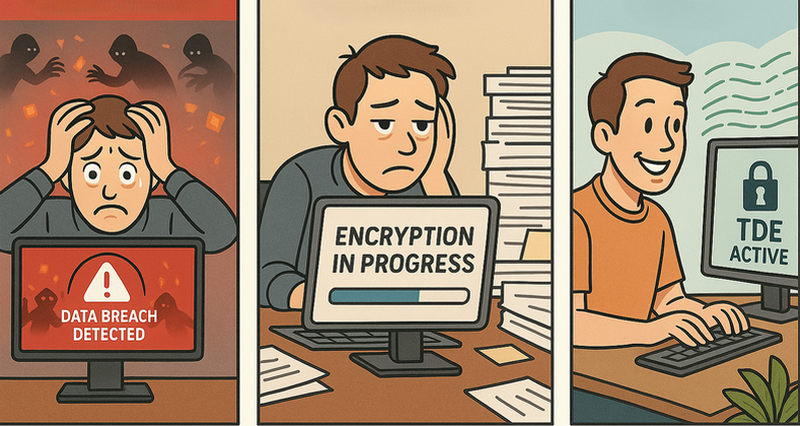
For any team dealing with sensitive information, TDE acts like a reliable security backbone — keeping your data protected and your daily operations running smoothly, with no trade-offs required.
What Really Makes TDE Different from Conventional Encryption?
While most encryption methods aim to safeguard sensitive data, they differ greatly in how they work under the hood. Let’s dive into what truly sets Transparent Data Encryption (TDE) apart:
File-Level Encryption
TDE operates at the file system level to protect all critical data within your database ecosystem. This includes core user data stored in tables and indexes, large objects (in TOAST tables), and system catalogs that preserve database metadata. It also encrypts write-ahead logs (WALs)—crucial for transaction recovery—and temporary files created during query execution.
Smartly, TDE skips encrypting non-user metadata (like transaction flags or file system naming structures), as encrypting these would disrupt normal database operations. This targeted approach ensures sensitive data stays secure while maintaining system performance.
Application Transparency
One of TDE’s biggest advantages is its independence from application code. All encryption and decryption are handled automatically by the database management system (DBMS), with no need to modify existing applications, APIs, or client drivers.
This means no downtime, no compatibility issues, and no changes required from developers. Both users and applications interact with data as usual—completely unaware that encryption is taking place in the background. That’s why it’s called “Transparent.”
Rock-Solid Cryptography
TDE uses advanced encryption algorithms to ensure robust data protection—most commonly the AES standard, which meets global security certifications such as NIST FIPS 140-2.
Depending on your security and performance needs, you can choose between AES-128, AES-192, or AES-256 bit keys. Longer keys provide stronger protection for highly sensitive data, while shorter ones offer faster performance.
Cross-Environment Compatibility
In traditional setups, encryption tools must be reconfigured for different environments. TDE eliminates this hassle—it’s designed to work seamlessly across all IT environments, making it ideal for today’s hybrid and multi-cloud infrastructures.
Whether you’re running on physical servers, virtual machines, containers, or cloud platforms like AWS, Azure, or Google Cloud, TDE provides consistent, reliable protection for your data everywhere.
Key Management
Even the strongest lock is only as secure as its key. That’s why key management is critical. Unlike traditional encryption, which relies on a single master key, TDE integrates with Key Management Systems (KMS) to securely store, rotate, and control key access.
In TDE, a master encryption key protects a separate data encryption key—meaning at least two keys are needed to decrypt a file. By keeping keys isolated from encrypted data, TDE ensures that even if storage media are stolen, the data remains unreadable without proper authorization.
Why You Need Encryption — and Why TDE?
With data breaches becoming more frequent and regulatory requirements growing more complex, keeping information secure has never been harder—or more urgent. The pressure is on for organizations to find smarter, more seamless ways to protect their data.
The Growing Threat and Cost of Data Breaches
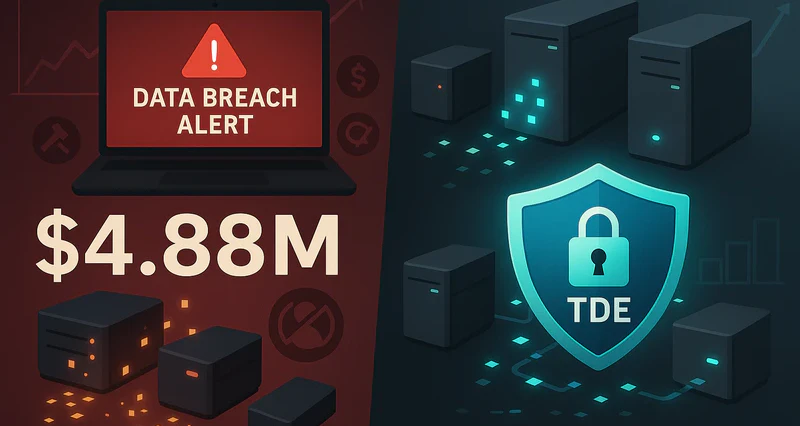
According to the 2024 IBM Cost of a Data Breach Report, the average cost of a data breach reached $4.88 million per incident—and the number continues to rise. Despite these multi-million-dollar losses, many organizations still struggle to prevent breaches. For instance, in 2022, Sixt Rent a Car, LLC suffered a major data breach after unencrypted cloud snapshots exposed employee information, leading to fines, reputational damage, and legal costs. Beyond targeted cyberattacks, lost or stolen storage devices—from laptops to external drives—remain a serious threat: a single misplaced server containing unencrypted customer data can result in a catastrophic breach.
To counter such risks, TDE acts as a crucial last line of defense. It ensures that even if your storage media is stolen or compromised, the data remains unreadable to unauthorized users.
Increasingly Strict Regulatory Requirements
As privacy awareness grows, so do the number and scope of data protection laws and standards. Regulations such as PCI DSS and HIPAA mandate strong encryption for sensitive data like cardholder and healthcare information. Meanwhile, GDPR considers unencrypted personal data a potential compliance violation.
This is where TDE makes a difference. It encrypts all sensitive information while allowing seamless decryption for authorized users, ensuring security without disrupting daily operations—and helping organizations stay compliant effortlessly.
The Hidden Risks of Insider Threats
Not all breaches come from the outside. Insider threats—whether intentional or accidental—are a major cause of data leaks. Within most organizations, privileged users across departments can access sensitive information, increasing the risk of misuse or unintentional exposure. TDE mitigates these risks by automatically encrypting files when they are closed and decrypting them when accessed by authorized users. This automation keeps data secure without slowing down workflow efficiency.
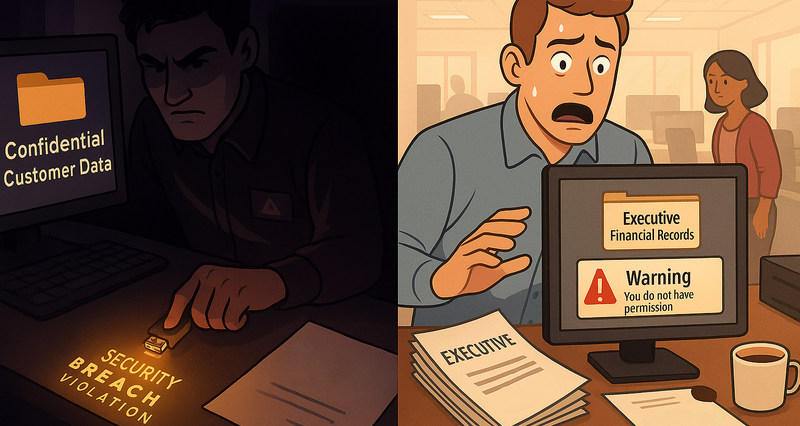
To learn more about insider threats, see our article: Insider Threats in 2026: Key Trends, Real Cases, and How to Prevent Them.
Many organizations struggle to balance security with productivity. AnySecura’s TDE solution solves this challenge through Transparent Data Encryption (TDE) and intelligent data classification—ensuring that only authorized employees can access specific data, without compromising operational efficiency.
FAQs about TDE
Does TDE encrypt all files on my device?
No. TDE does not encrypt non-user metadata (such as file names, database size metrics), system files, or configuration logs, since doing so could cause system errors. It only encrypts data files and backups. You can also set up a whitelist to exclude specific files or directories from encryption, and authorize certain applications to automatically encrypt or decrypt data as needed.
Does TDE cause significant performance degradation?
No, performance impact is minimal. Thanks to modern hardware acceleration and optimized encryption algorithms, the overhead introduced by TDE is typically less than 5%. With proper system tuning, most organizations find the performance difference almost unnoticeable.
Does TDE replace other security measures?
No. Data security is a multi-layered defense system—you shouldn’t put all your eggs in one basket. While TDE plays a vital role in protecting data at rest, it should be combined with access controls, regular audits, and data loss prevention (DLP) tools to form a comprehensive security strategy. Additionally, staying informed about emerging threats and the latest TDE advancements is crucial for keeping your defenses strong and adaptive.
How Will TDE Evolve in the Future?
Every technology is born to solve a problem—and TDE is no exception. It’s designed to safeguard data while minimizing the performance impact of encryption and decryption. Moving forward, TDE will continue to evolve toward greater intelligence, efficiency, and adaptability.
- Cross-Industry Applications: As data privacy becomes increasingly critical, organizations across diverse industries are turning to TDE to protect sensitive information with minimal performance loss and cost. This includes sectors such as Financial Services, Healthcare, Government and Public Sector, and Cloud-First Enterprises.
- AI-Powered Key Management: With AI rapidly advancing, integrating artificial intelligence and machine learning into TDE’s Key Management Systems (KMS) will help automate key rotation, detect abnormal access patterns, and predict potential security vulnerabilities—making encryption management smarter and more proactive.
- Quantum-Resistant Encryption: As quantum computing matures, preparing for post-quantum threats will become essential. Future TDE implementations are expected to integrate quantum-resistant algorithms to ensure long-term data protection in a new computing era.
- Zero-Trust Architecture Alignment: Zero-Trust remains a dominant trend in cybersecurity. In the future, TDE will serve as a key pillar of Zero-Trust strategies. By combining TDE’s granular encryption controls with robust identity and access management (IAM), organizations can fully embody the principle of “never trust, always verify.”
Conclusion
In short, TDE is an encryption solution that robustly protects your data while operating seamlessly in the background, without disrupting your workflow. As security threats continue to grow in complexity, TDE is expected to play an increasingly important role across industries, helping prevent data breaches effectively.
If you want to strengthen your data protection while keeping impact on workflow and costs minimal, you can try AnySecura and experience comprehensive TDE protection firsthand.