
Microsoft Purview is Microsoft's data security and compliance platform for enterprises, covering data loss prevention, classification, information protection, and risk management. Businesses with different IT environments, budgets, or priorities may find that other Microsoft Purview alternatives fit their needs better.
This guide compares 8 alternatives to Microsoft Purview by deployment, capabilities, and pricing, so you can see what different Microsoft Purview competitors have to offer.
Microsoft Purview vs. Alternatives: Quick Comparison
The table below provides a quick comparison of Microsoft Purview and the 8 alternatives covered in this guide.
| Solution | Deployment | Core Strengths | Best For | Pricing Model |
|---|---|---|---|---|
| Microsoft Purview | Cloud | DLP, data governance, compliance and risk management | Microsoft 365 data protection | Per-user licensing, bundled in Microsoft 365 E5 or as a Purview add-on for E3, plus pay-as-you-go pricing for some workloads |
| AnySecura | On-premises | Endpoint DLP, activity monitoring, device control | Windows endpoint DLP with granular activity controls | Per-seat annual subscription, starting from $216/seat/year, with volume discounts available |
| Forcepoint DLP | Cloud / on-premises | Enterprise DLP, data discovery and risk prevention | Behavior-Based Risk-Adaptive DLP | Custom quote-based subscription; no list pricing published, contact sales for a quote |
| Symantec DLP | Cloud / on-premises | Enterprise data protection, DLP and data discovery | Large-scale, multi-channel DLP for complex IT environments | Subscription licensed per managed device or managed user; no list pricing published, contact Broadcom sales |
| Trellix DLP | Cloud / on-premises | DLP, data discovery, classification and endpoint protection | DLP within a unified security console | Custom quote-based subscription; no list pricing published, contact sales for a quote |
| Netskope | Cloud | Cloud security, SSE, DLP and data protection | SaaS and cloud-native data security (CASB/SSE) | Custom quote-based subscription; no list pricing published, contact sales for a quote |
| Fortra DLP (formerly Digital Guardian) | Cloud / on-premises | IP protection, endpoint DLP | Intellectual property protection | Tiered subscription; no list pricing published, request a quote |
| Netwrix Endpoint Protector | Cloud / on-premises | USB and device control, endpoint DLP | Cross-platform USB and device control (Windows/Mac/Linux) | Custom quote-based subscription; no list pricing published, request pricing from Netwrix |
| Safetica | Cloud / on-premises | DLP, insider risk protection, data protection | Insider risk management for mid-sized teams | Per-user annual subscription starting at $72 (Standard), $96 (Premium), or $144 (Enterprise); On-Prem is quote-based |
This table is intended as a quick way to narrow down your options. A more detailed evaluation should also consider your IT environment, security requirements, compliance needs, and budget.

Comparing Trellix against other options? See how it stacks up against AnySecura, CrowdStrike Falcon, Microsoft Defender, and more. Learn more>>
Why Do Businesses Look for Microsoft Purview Alternatives?
The reasons usually come down to how well Purview's approach fits a business's actual IT environment, team structure, and data protection priorities, more than any single missing feature. Four factors come up most often:
1. Strong Dependence on the Microsoft Ecosystem
Integration with Microsoft 365 and other Microsoft products is one of Microsoft Purview's key strengths.
However, businesses that use a mix of Windows, macOS, Linux, third-party SaaS applications, and other IT systems may prefer a data security solution that can fit more flexibly into a mixed IT environment.
2. Licensing and Costs Require Careful Evaluation
The actual cost of Microsoft Purview depends on factors such as the Microsoft 365 licences an organisation already has, the features it needs, and how those capabilities are deployed. Businesses therefore need to understand which features they require and what is already included in their existing licences.
For organisations looking for a simpler pricing structure or more predictable security costs, third-party solutions may be worth considering.
3. More Granular Endpoint Data Control
Microsoft Purview already includes Endpoint DLP and policy enforcement capabilities, covering activities such as USB transfers, printing, browser uploads, and clipboard copying on Windows and macOS devices. For some organisations, though, these controls may not offer enough granularity. They may be looking for a different combination of deployment model, OS coverage, licensing structure, feature depth, or day-to-day management overhead than what Purview currently offers.
4. Different Industries Have Different Data Protection Priorities
The type of data that needs protection varies from one business to another.
Financial organisations may prioritise customer and financial data, while healthcare organisations need to protect patient information. Software companies may place greater emphasis on source code and intellectual property, while manufacturers may need to protect engineering drawings and technical documents.
Instead of simply comparing the number of features, businesses should focus on the data they actually need to protect and the risks they are most likely to face.
Compare 8 Symantec DLP alternatives by deployment, key strengths, and best fit to find the right replacement for your organization. Learn more>>
What to Look for When Comparing Microsoft Purview Alternatives
Once you know why you might be looking elsewhere, the next step is knowing what to actually check when you compare specific products. Five factors are worth evaluating for each alternative:
Deployment Options
First, determine whether the solution supports cloud, on-premises, or hybrid deployment.
If your organisation has strict requirements around data storage, data residency, or internal infrastructure, an on-premises or hybrid solution may be more suitable. Businesses that want faster deployment and less infrastructure maintenance may prefer a cloud-based solution.
Core Data Security Capabilities
Key capabilities to compare include:
Different products cover these areas to different degrees, so prioritise the capabilities that are most relevant to your business.
Pricing Model
Look beyond the sticker price on the licence and check how each product is actually billed, by user, device, feature module, or data volume. Add in deployment, maintenance, and ongoing management costs. For most businesses, total cost of ownership (TCO) ends up being the more useful number to work from.
Business Size
The right fit often comes down to scale. Larger organisations typically need to support more endpoints, enforce more complex security policies, and manage everything centrally. Smaller businesses tend to prioritise how quickly they can deploy, how much ongoing management the tool requires, and whether pricing stays predictable as they grow. The same solution rarely serves both ends of that spectrum equally well.
Industry and Business Requirements
Your industry and the type of data you handle matter just as much as company size. A solution that's strong on IP protection isn't necessarily the right choice for a business whose main risk is customer data exposure, and vice versa, so it's worth anchoring the decision to the specific data you're protecting rather than a product's general category.
8 Microsoft Purview Alternatives
The following 8 products are ranked based on their data protection capabilities, endpoint controls, deployment options, and typical use cases, not simply by market recognition. Each product has a different focus, so a lower position doesn't mean a product is less capable. The goal is to help businesses find the solution that best matches their specific needs.
1. AnySecura
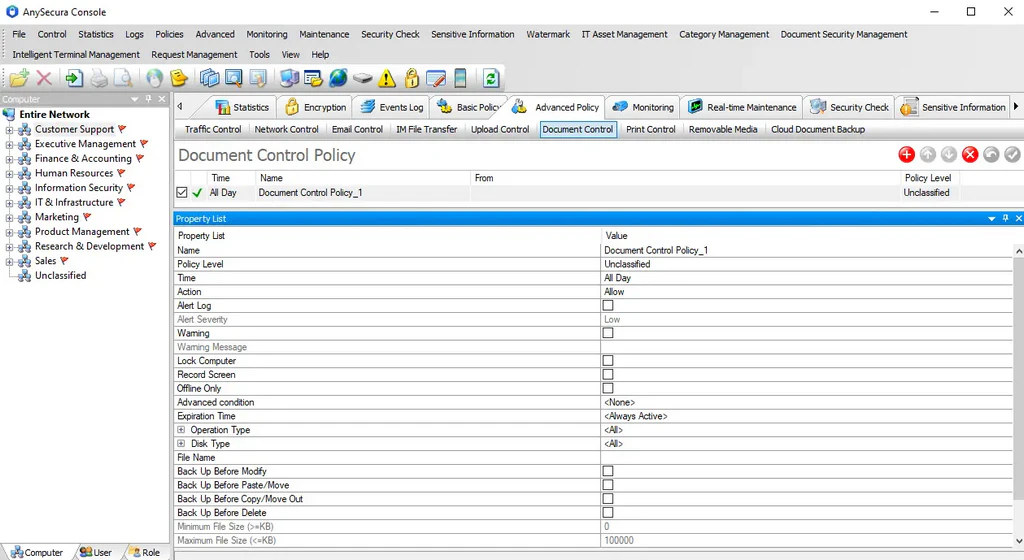
AnySecura is an endpoint-focused data security solution built around an agent-and-console architecture, with on-premises deployment and modular controls for areas such as DLP, device and removable media control, print control, document protection, transparent encryption, and activity monitoring. Compared with Microsoft Purview, the key differences are its endpoint-focused architecture, deployment model, modular approach to endpoint controls, and per-device licensing, making it worth considering for organisations that want more specialised control over data and user activities on Windows endpoints.
Core capabilities include:
 Transparent encryption: automatically encrypts and decrypts specified file types without the employee even noticing, so documents stay unreadable even if they're sent to the wrong person or leaked externally.
- Sensitive content identification and peripheral control: restricts data from leaving through USB drives, printing, and instant messaging apps, cutting off high-risk exit points at the source.
- Watermarking across screens, documents, and printing: one of the capabilities where AnySecura stands out most from competitors. Even if sensitive content leaks through a screenshot or a printed page, the watermark can be traced back to the specific user, acting as both a deterrent and a way to trace leaks after the fact.
- Real-time screen monitoring and user activity auditing: cover the "during" and "after" sides of data use, helping businesses reconstruct exactly how employees accessed, copied, and transferred company data.
For organisations that need more than basic DLP and want to control how employees access, copy, transfer, print, and use business data, AnySecura is worth considering as a Microsoft Purview alternative.
Things to consider: AnySecura's alerts are policy-triggered rather than behavior-based, so it doesn't build dynamic risk profiles per user the way Forcepoint or Netskope do. Organisations that need adaptive, behavior-driven risk scoring across a large or fast-changing workforce may find a rules-based approach less flexible to manage at scale.
Source: AnySecura
2. Forcepoint DLP
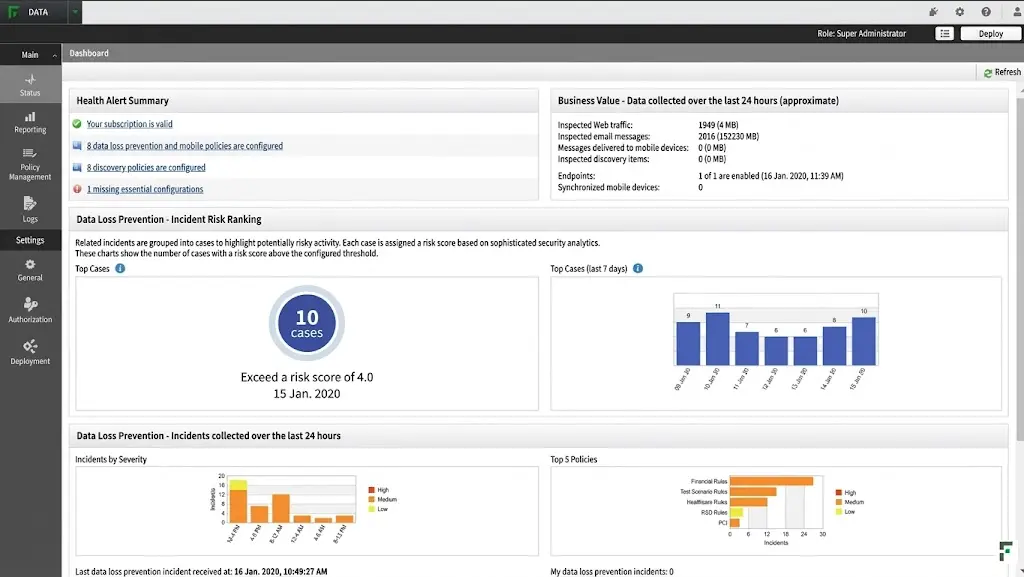
Forcepoint is a longstanding name in data security, and its DLP line's biggest selling point is Risk-Adaptive Protection. This combines traditional policy enforcement with user behaviour analysis, so the system can adjust to each individual rather than applying the same level of scrutiny to everyone. That approach tends to work particularly well in large, complex organisations, where static, one-size-fits-all policies often generate a flood of false positives or miss real risks entirely. It's deployed in the cloud or on-premises, with custom quote-based pricing available by contacting the sales team.
Core capabilities include:
- Risk-adaptive protection: combines DLP policy enforcement with behavioural analytics to build an ongoing risk profile for each user, then dynamically adjusts how strictly policies are enforced. This catches high-risk behaviour while reducing friction for lower-risk employees going about their normal work.
- Multi-channel coverage spanning endpoints, network, cloud applications, and email, with email control handled in an agentless way, so this high-risk channel is covered without deploying any extra components on the client side.
- A compliance template library, with over 1,700 policy templates and classifiers covering more than 80 countries, which helps multinational businesses get ahead of requirements like GDPR and HIPAA faster.
Forcepoint tends to be the best fit for mid-sized and large organisations with a mature security team, one that can handle more complex policy configuration and the ongoing maintenance that comes with it, particularly organisations with over 200 employees managing hybrid or multi-cloud environments.
Things to consider: Forcepoint DLP can support complex cloud, on-premises, and hybrid deployments, but larger deployments may require multiple server components and additional network configuration. Hybrid public-cloud deployments, for example, can require site-to-site VPN connectivity and static IP addresses, so implementation may require more infrastructure planning than a purely SaaS-based DLP service.
Source: Forcepoint DLP
3. Symantec DLP
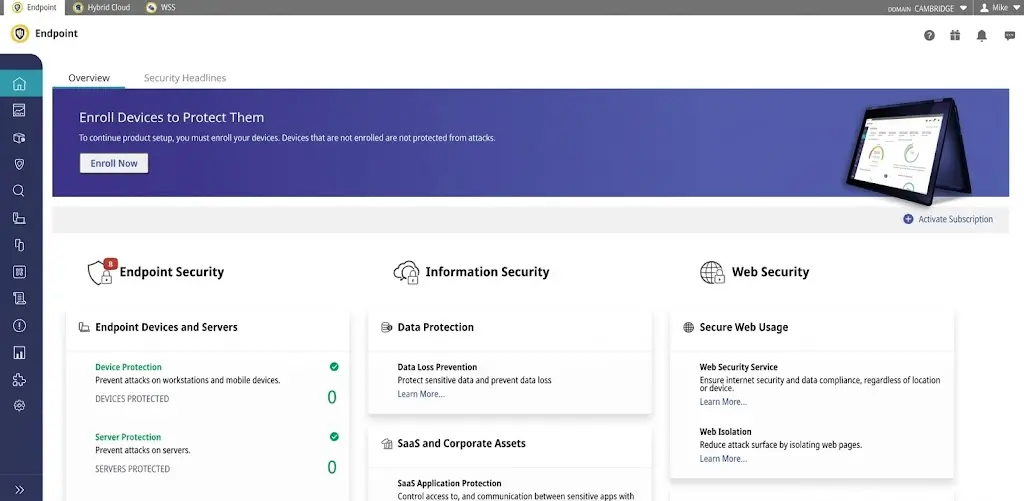
Symantec DLP is one of the longest-standing data loss prevention solutions on the market. Its roots trace back to Vontu, which was acquired and folded into Symantec, and the product now sits under Broadcom. That long track record has helped it build a mature policy template library and a large base of enterprise deployments, with particularly deep roots in heavily regulated industries like finance and healthcare. Its real strength isn't any single standout feature, it's breadth of coverage: endpoint, network, and cloud can all be managed under one policy, which is a real convenience for large organisations already dealing with complex IT architecture. It's deployed in the cloud or on-premises, billed per managed device or managed user, with custom quote-based pricing available through Broadcom's sales team.
Core capabilities include:
- Full environment coverage across endpoint, network, and cloud, making it possible to apply one consistent data protection policy across a genuinely complex IT setup instead of piecing together separate tools for each environment.
- A multi-tier architecture, where core components like the database, policy enforcement server, and detection servers each run on dedicated infrastructure, which is what allows it to handle large-scale, cross-environment monitoring and policy enforcement.
- Data discovery and classification: helps businesses figure out where their sensitive data actually lives before building targeted protection policies around it, rather than applying blanket controls across the board.
Worth noting: this multi-tier architecture also means deployment and maintenance need a reasonably sized, dedicated IT infrastructure team to support it properly, which makes it a better fit for large organisations than businesses looking for a lighter-weight deployment.
Things to consider: Symantec DLP's broad endpoint coverage can come with a higher infrastructure and management requirement. Broadcom notes that the Endpoint Agent interacts with many processes on the host and that performance can vary depending on the agent configuration and scope of monitoring, so organisations should validate endpoint performance during a proof of concept.
Source: Symantec DLP
4. Trellix DLP
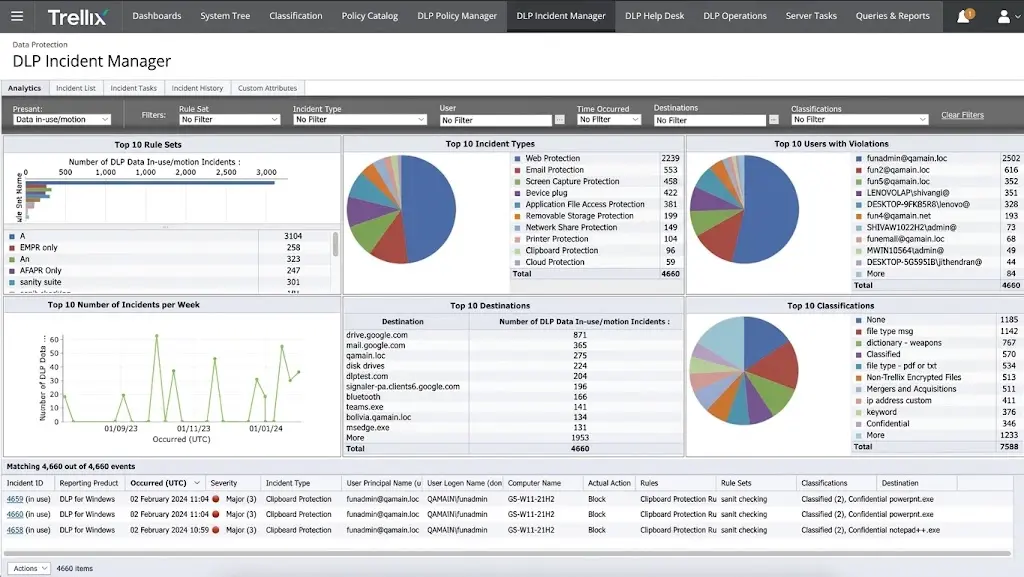
Compared to the other options here, one of Trellix DLP's standout advantages is that it plugs directly into Trellix's ePO (ePolicy Orchestrator) console, sharing the same management interface as endpoint protection and email security. It's deployed in the cloud or on-premises, with custom quote-based pricing available by contacting the sales team.
Core capabilities include:
- Unified console management, bringing data discovery, endpoint protection, and ongoing monitoring together in one place. If a business is already using Trellix's endpoint protection or email security, DLP can plug straight into that same console, cutting down on the overhead of juggling multiple tools.
- Data discovery and classification, with built-in pre-set classification templates that help identify where sensitive data actually sits and what type it is, forming the foundation for policy configuration.
- Compliance support, with built-in frameworks for regulations like GDPR, HIPAA, and PCI DSS, suited to organisations that need to handle data security and compliance requirements at the same time.
If a business is already using other Trellix security products, unified console management is the biggest advantage on offer. But if DLP would be the only Trellix product in the mix, it's worth weighing the setup cost and complexity against a more focused, single-purpose DLP tool.
Things to consider: Trellix DLP Endpoint Complete currently focuses on Windows and macOS workstations and servers. Organisations with Linux-heavy endpoint environments should verify whether the required endpoint controls are available through other Trellix DLP components or whether additional solutions are needed.
Source: Trellix DLP
5. Netskope
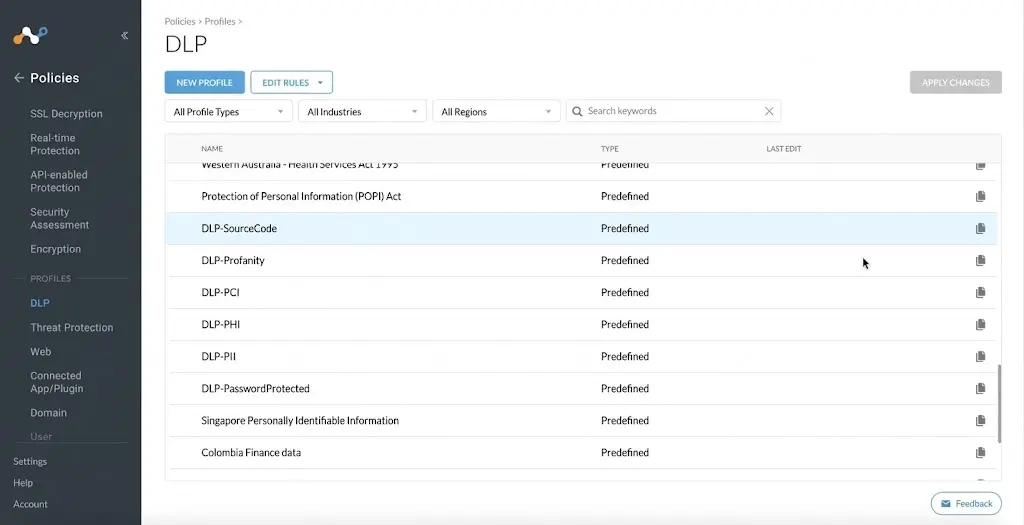
Unlike the endpoint and network-focused DLP tools covered so far, Netskope is cloud-native by design, built around CASB (Cloud Access Security Broker) and SSE (Security Service Edge) rather than extending cloud capabilities onto a traditional endpoint DLP base. That architectural difference is what gives it a level of depth in SaaS and multi-cloud scenarios that most endpoint-side DLP tools simply can't match. It's deployed entirely in the cloud, with custom quote-based pricing available by contacting the sales team, though the general market consensus is that its pricing sits at the higher end.
Core capabilities include:
- Cloud Access Security Broker (CASB), which governs employee access to SaaS applications and how data moves through them. Its Cloud Confidence Index assesses the risk of more than 80,000 cloud applications, covering far more ground than anything inside the Microsoft ecosystem alone.
- Dual-mode data scanning, supporting both inline real-time traffic scanning and API-based scanning of data at rest, so it can catch risk both as data moves and after it's already sitting in a SaaS platform.
- User and entity behaviour analytics, which helps flag unusual access patterns and supports shadow IT detection (unapproved cloud apps being used without IT's knowledge) alongside cloud application access control.
For businesses moving towards a cloud-first architecture, or storing significant amounts of data in SaaS applications, Netskope is an important option outside of Microsoft Purview. Worth keeping in mind: its admin console has a steeper learning curve, and its core strength lies in cloud and web traffic rather than endpoint devices themselves.
Things to consider: Netskope has broad cross-platform client support, but Endpoint DLP coverage is not identical across operating systems. For example, the Netskope Client documentation lists Endpoint DLP for supported Windows and macOS environments, while Linux currently does not provide the Endpoint DLP service. Organisations with Linux-heavy endpoint environments should therefore verify the exact controls available on their devices.
Source: Netskope
6. Fortra DLP (formerly Digital Guardian)
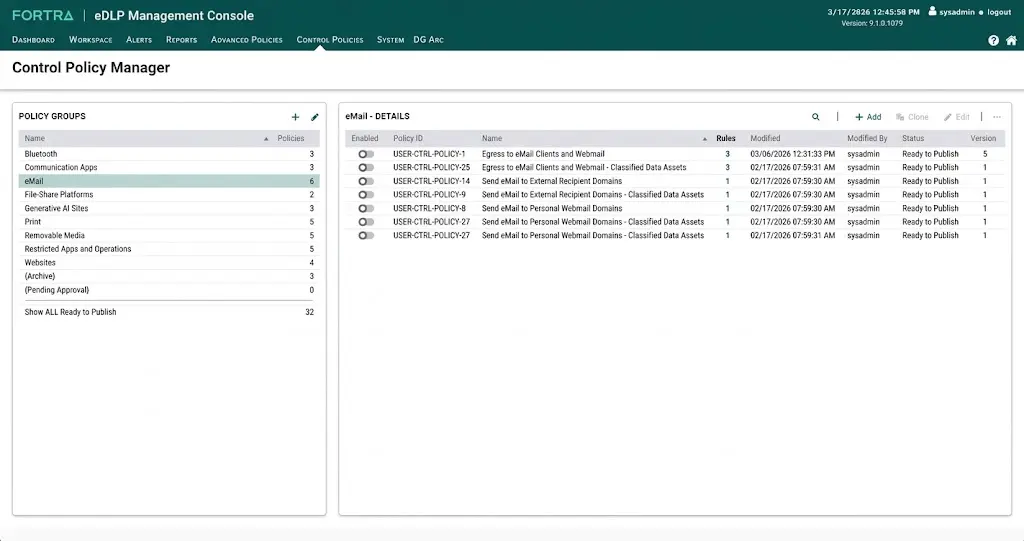
Digital Guardian was once one of the most recognised independent DLP brands in the intellectual property protection space. After being acquired by Fortra and folded into its security portfolio, it was rebranded as Fortra DLP, though its core focus hasn't changed. Unlike general-purpose DLP tools that try to cover everything, it was built from the ground up around protecting high-value intellectual property, and its customer base leans heavily towards software, manufacturing, and R&D companies, where a data leak often means losing core assets rather than just compliance exposure. It's deployed in the cloud or on-premises, with SaaS and managed service options also available, and priced as a tiered subscription available by request.
Core capabilities include:
- Intellectual property protection, since for software, manufacturing, and R&D companies, data loss risk goes well beyond customer information. Source code, design files, and research materials are just as attractive a target, and this focus is what sets Fortra DLP apart from more general-purpose DLP tools.
- Data activity monitoring, tracking a piece of data's full lifecycle from creation through editing and transfer, which makes it easier to trace how high-value data actually moves.
- Pre-built dashboards and compliance policies, included when delivered as a SaaS or managed service, which helps organisations that don't want to build everything from scratch get up and running faster.
Fortra DLP is best suited to businesses where protecting high-value intellectual property is the top priority, rather than those that just need DLP to satisfy general compliance requirements.
Things to consider: Fortra DLP provides broad protection across Windows, Mac, and Linux, but mobile data protection is more limited. The Radicati Group has noted that Digital Guardian's mobile DLP capabilities are limited and may require third-party MDM or EMM solutions, so organisations with significant mobile-device data risks should evaluate this area separately.
Source: Fortra DLP
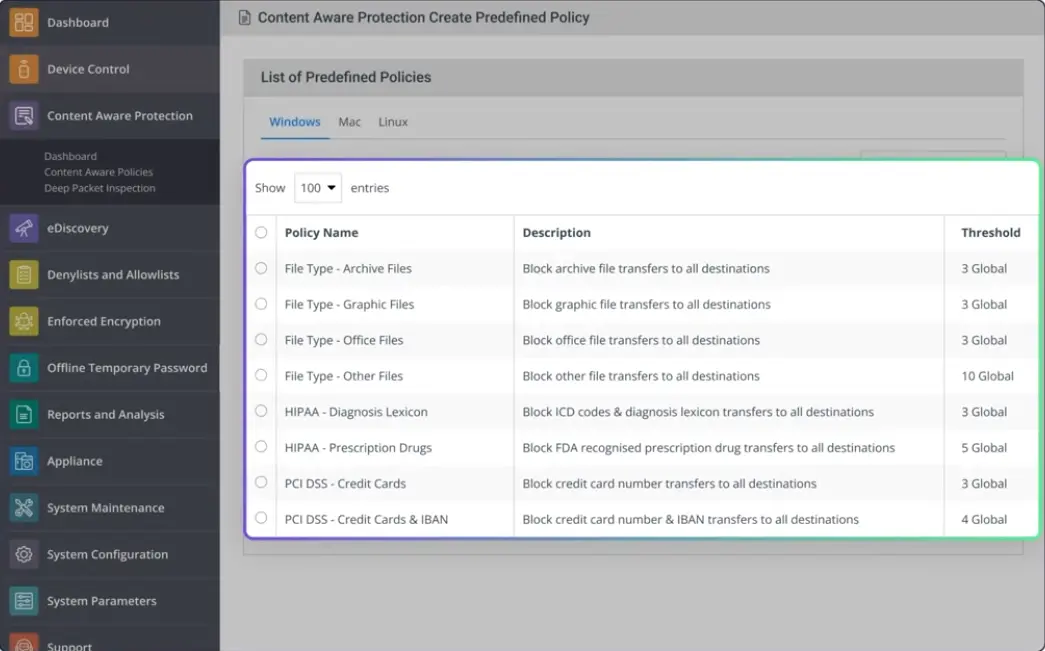
7. Netwrix Endpoint Protector
Endpoint Protector was originally developed by CoSoSys, which spent years focused specifically on device control and content-aware DLP. It was later acquired by identity and data security vendor Netwrix and rebranded as Netwrix Endpoint Protector as part of its product line. Within the device control niche, it stands out for two things: native support for Windows, macOS, and Linux, which is uncommon among comparable tools, and offline policy enforcement that keeps working even in a fully disconnected environment. Together, these give it a clear fit for organisations with mixed endpoint environments or air-gapped network requirements. It's deployed in the cloud or on-premises, with custom quote-based pricing available by request from Netwrix.
Core capabilities include:
- Cross-platform device control, covering USB and removable storage management across Windows, macOS, and Linux, useful for organisations managing a mix of endpoint types under one policy.
- Offline policy enforcement, which keeps working in offline or air-gapped network environments, a fit for organisations with air-gapped networks or restricted network requirements, such as classified facilities or manufacturing floors.
- File transfer control and device auditing, logging device connections and file transfer activity so it can be traced back after the fact.
Its strength is mainly at the endpoint and device layer, so organisations whose risk also involves data already sitting in SaaS platforms will likely still want to pair it with a cloud-focused DLP or CASB tool to cover that ground. For organisations where USB and removable device control is a major security concern, Netwrix Endpoint Protector is a strong option to consider among Microsoft Purview alternatives.
Things to consider: Netwrix Endpoint Protector supports Windows, macOS, and selected Linux distributions, but Linux coverage is not universal. Distributions such as Debian, Fedora, SUSE, OpenSUSE, SLED, Pardus, and AWS Linux 2 are not supported by default and may require a Feature Request for a custom client, which can involve additional validation and potentially billable services.
Source: Netwrix Endpoint Protector
8. Safetica
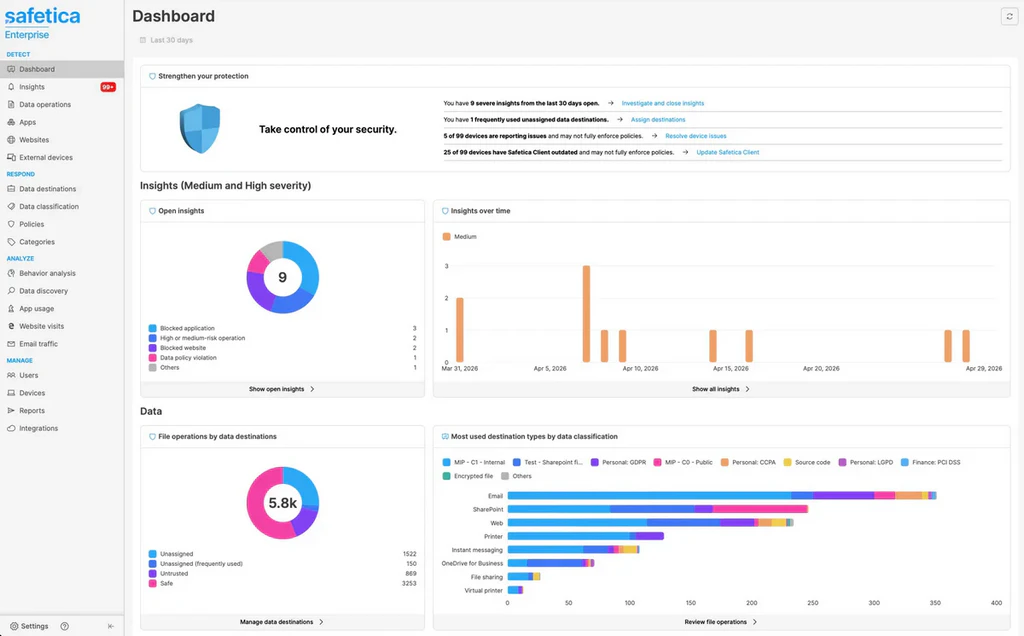
Unlike the enterprise-grade platforms covered above, which generally need a dedicated security team to get real value from, Safetica takes a lighter-weight approach, combining insider risk management and DLP into a product that's easier to pick up, so IT teams without dedicated security analysts can still run it independently. It's deployed in the cloud or on-premises, billed as a per-user annual subscription with pricing split across Standard at $72, Premium at $96, and Enterprise at $144, while the on-premises version is quote-based.
Core capabilities include:
- A lighter operational model, built for IT teams rather than organisations with dedicated insider risk analysts, which keeps the learning curve relatively low.
- Employee activity monitoring and insider risk management, helping businesses identify sensitive data and control how it's used and transferred in day-to-day work, covering both data leak prevention and visibility into internal data use.
- Data classification and file protection, identifying sensitive data types first, then matching them to the appropriate protection policy.
For organisations that want to combine data leak prevention with visibility into how employees actually use data, without the operational overhead that comes with running a full enterprise setup, Safetica is worth comparing.
Things to consider: Safetica currently does not support ARM-based Windows operating systems, and macOS deployments require permissions to be granted through an Apple Configuration Profile. Organisations with Windows on ARM devices or tightly controlled macOS environments should verify endpoint compatibility and deployment requirements before rollout.
Source: Safetica
Want a closer, head-to-head look at some of these DLP vendors? See how they compare on features, pricing, and deployment. Learn more>>
How to Choose the Right Microsoft Purview Alternative
Now that you've seen what each of the 8 options actually offers, the next question is which one fits your situation. That comes down to four things: your business size, industry, IT environment, and the specific risks you're trying to reduce.
Consider Your Business Size and Security Needs
Organisations with a complex structure, multiple regions, or hybrid IT environments generally need broader coverage and centralised management. Smaller or single-site teams tend to be better served by something faster to deploy and easier to manage day to day, though deployment flexibility, including support for distributed or multi-site setups, is worth checking even for solutions marketed at smaller teams.
Match the Solution to Your Industry and Data Protection Needs
If your main priority is protecting data and meeting compliance requirements, DLP, data classification, and compliance support should carry the most weight in your evaluation.
If you're in software development, manufacturing, or R&D, source code and intellectual property protection likely matter more than general compliance, which is where Fortra DLP fits in.
If your business runs heavily on SaaS and cloud services, cloud data protection should carry more weight than endpoint-specific controls, which is where Netskope fits in.
And if your biggest exposure is at the endpoint itself, such as USB devices, printing, or file transfers, AnySecura or Netwrix Endpoint Protector are built specifically around that layer of control.
Compare Pricing, Features, and Total Cost
Once you've narrowed things down, weigh the total cost against what you'll actually use, not just the number on the price list. If your security needs are clearly defined, a solution built around your specific risk, like device control or IP protection, can end up costing less overall than a broad platform loaded with capabilities you'll never touch.
FAQ
Is Microsoft Purview a DLP Solution?
Yes. Microsoft Purview includes Data Loss Prevention (DLP), along with capabilities for data classification, information protection, compliance, and risk management. It is therefore more than a traditional DLP tool and is better viewed as a broader data security and compliance platform.
Why Do Companies Replace Microsoft Purview?
The reasons vary from one organisation to another. Common factors include the level of Microsoft ecosystem dependence, licensing costs, management requirements, and the need for more granular endpoint controls.
In some cases, businesses are not replacing Purview because it lacks features. They may simply be looking for a solution that better fits their IT environment or specific security priorities.
What Is the Best Microsoft Purview Alternative for Small Businesses?
For small and medium-sized businesses, the most important factors are often ease of deployment, management requirements, core data protection capabilities, and overall cost.
AnySecura and Safetica can be considered as options, but the right choice will depend on the type of data being protected, the number of endpoints, and the organisation's security requirements.
Conclusion
Purview covers a lot of ground on its own, but the right data security setup for your business ultimately depends on your IT environment, your team's bandwidth, and the specific risks you're managing day to day.
From endpoint data protection and cloud security to intellectual property and device control, the 8 solutions covered in this guide each bring something different to the table. If your organisation places greater emphasis on endpoint data protection, device control, and employee activity monitoring, AnySecura is worth considering.
Want to see whether AnySecura fits your security needs? Start your free trial of AnySecura and evaluate its data protection and endpoint management capabilities in your own environment.