
Symantec DLP has long been a common choice for enterprise data protection. But since Broadcom acquired Symantec, some existing customers have started to reassess the DLP software they have relied on for years. Licensing costs, product packaging, support experience, and the future product roadmap are all factors driving this evaluation. As a result, more businesses are looking for Symantec DLP alternatives.
This article first explains what Symantec DLP is and why businesses may consider replacing it. We then compare eight widely considered alternatives to Symantec DLP based on different evaluation criteria to help you determine which option best fits your environment.
Symantec DLP Alternatives Comparison
Before looking at each product in detail, the table below provides a quick comparison of eight Symantec DLP alternatives and competitors and their main positioning and capabilities.
No single solution is the best in every category. The right choice depends on which problems matter most to your organization.
| Product | Best For | Deployment | Key Strength | Best Fit |
|---|---|---|---|---|
| Forcepoint DLP | Global Compliance & Cross-Channel DLP | On-premises / Cloud / Hybrid | Extensive predefined policies for complex DLP environments | Large organizations with multiple regions and business units |
| AnySecura | Endpoint DLP & Unified Endpoint Control | On-premises | Manages files, devices, applications, printing, and other endpoint activities in one platform | Windows-focused organizations looking for stronger endpoint control |
| Proofpoint Enterprise DLP | Email & Cloud Data Protection | Cloud / SaaS | Strong email security with endpoint and cloud data protection | Organizations with significant email and cloud collaboration risks |
| CrowdStrike Falcon Data Protection | DLP for Existing Falcon Environments | Cloud-managed | Can leverage the existing Falcon Agent and platform | Organizations already using CrowdStrike |
| GTB Technologies DLP | Cross-Channel Data Protection | On-premises / Cloud | Covers multiple data movement channels | Organizations looking for cross-channel DLP |
| Fortra DLP | Data Classification & IP Protection | On-premises / SaaS / Managed | Focuses on protecting sensitive data and intellectual property | IP-intensive organizations |
| Trend Micro DLP | DLP Within a Unified Security Platform | On-premises / Cloud | Works with other Trend Micro security capabilities | Organizations already using Trend Micro |
| ManageEngine Endpoint DLP Plus | SMB Endpoint Data Protection | On-premises | Focuses on USB, files, printing, and other endpoint risks | Small and mid-sized businesses focused on endpoint DLP |
Note: Specific features may vary by product version, license, and module. Organizations should confirm the current capabilities and deployment options with the vendor before purchasing.
What Is Symantec DLP?
Symantec DLP, now operated by Broadcom, is one of the more established enterprise DLP solutions. It covers multiple channels, including endpoints, networks, storage, email, and cloud applications.
Its core technologies include Exact Data Matching (EDM) and Indexed Document Matching (IDM). Compared with basic rule-based matching, these technologies can improve detection accuracy and help reduce false positives. This has made Symantec DLP a common choice for large organizations in industries such as finance, healthcare, and government.
The product is still being updated. DLP 25.1, released in July 2025, continued to support the platform's existing multi-channel data protection capabilities. DLP 26.1, released in April 2026, added greater visibility into the use of generative AI applications.
In other words, Symantec DLP remains technically capable. For many businesses, the bigger concerns are related to the commercial and operational side of the product after Broadcom's acquisition. That's what we will look at next.
Why Are Businesses Looking for Symantec DLP Alternatives?
Complex Deployment and Management
Symantec DLP can involve multiple components, including an Oracle database, Enforce Server, and Detection Servers. Depending on whether a single-tier, two-tier, or three-tier architecture is used, deployment can require significant time and specialized knowledge.
For organizations without a dedicated DLP team, getting the platform up and running can already be a major project. Ongoing policy tuning and day-to-day maintenance also require continued effort.
Cost and Licensing Considerations
Since Broadcom acquired Symantec, some customers have been reassessing licensing costs, product packaging, and contract terms. Changes in pricing and licensing models have become another factor for businesses considering migration.
This is also similar to some of the concerns raised by customers following Broadcom's acquisition of VMware, making commercial considerations an important part of the discussion around migration.
Growing Cloud and SaaS Risks
As more sensitive data moves into SaaS platforms, cloud storage, and generative AI applications, businesses are asking more from their DLP solutions.
DLP is no longer limited to traditional channels such as email, web traffic, and endpoints. Organizations increasingly need protection across cloud applications and newer data-sharing scenarios. For some traditional DLP platforms, this means expanding their capabilities to cover more cloud-based and emerging data flows.
Different Business Requirements
Not every organization has the same data protection requirements.
Large enterprises may prioritize data discovery, classification, and centralized policies across multiple data channels. Mid-sized businesses, on the other hand, may be more concerned about USB devices, printing, web uploads, and employee endpoints. They may also want encryption, access control, and application control in the same platform instead of integrating several separate tools.
For this reason, finding a Symantec DLP alternative is not simply about finding a product with more features. It is about finding a solution that better matches the organization's size, IT environment, operational resources, and security requirements.
What Should You Look for in a Symantec DLP Alternative?
When comparing DLP products, businesses should focus on their actual data protection scenarios rather than simply counting features.
- Deployment options and time: Is the solution available on-premises, as SaaS, or in a hybrid model? Can it be deployed in days or does implementation take months?
- Detection technologies: Does it rely on rules and regular expressions, EDM/IDM-style matching, or AI-based contextual classification?
- Channel coverage: Can it protect endpoints, networks, email, cloud applications, and generative AI tools?
- Endpoint control: Beyond detection and alerts, does it provide encryption, application control, and device management?
- Compliance support: Does it include predefined policies or templates for regulations such as GDPR, HIPAA, and PCI DSS?
- Pricing and total cost of ownership: Is pricing transparent? Does the licensing model provide enough flexibility?
- Integration with the existing security stack: Can the solution work with existing agents or security platforms?
The 8 Best Alternatives to Symantec DLP
The products below are not ranked in an absolute order of quality. Each has a different focus in terms of data protection coverage, deployment options, and target customers.
1. Forcepoint DLP
Forcepoint DLP is an established enterprise data loss prevention solution designed for organizations that need to enforce consistent data protection policies across complex IT environments.
One of its key strengths is its mature policy engine. It offers more than 1,700 predefined templates and classifiers covering regulatory requirements across more than 150 regions. Combined with risk-adaptive protection, it can adjust policy enforcement based on user and data risk instead of applying the same rules to everyone.
For large organizations operating across multiple countries and dealing with complex compliance requirements, this out-of-the-box coverage can reduce the amount of work required to build policies from scratch.
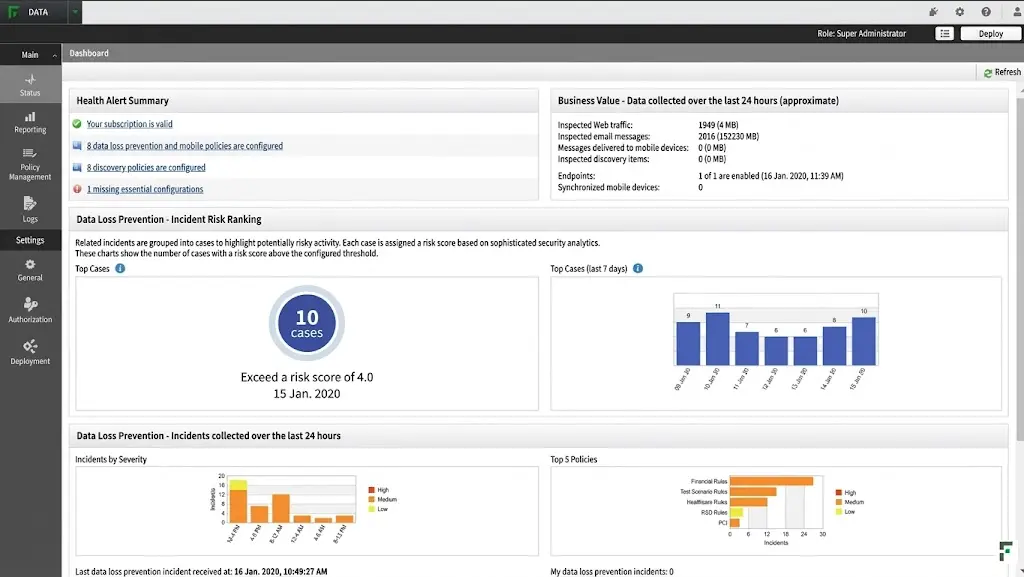
Source: Forcepoint DLP
Key features
- More than 1,700 predefined compliance templates covering regulations across 150+ regions
- Risk-adaptive protection that adjusts data protection policies based on user and data risk
- Mature policy management for organizations with multiple regions and business units
Why Consider Forcepoint DLP?
If the main problem with Symantec DLP is deployment and management complexity rather than a lack of functionality, Forcepoint can be a practical migration option.
Its extensive compliance templates and policy automation can reduce the effort required to build and maintain policies, making it a strong fit for organizations looking to reduce operational overhead.
Why Not Consider Forcepoint DLP?
Forcepoint DLP can require additional infrastructure and database administration, particularly for larger on-premises deployments. Its documentation states that Microsoft SQL Server is used for the reporting database, and larger deployments are advised to use SQL Server Standard, Business Intelligence, or Enterprise on a separate server from the Forcepoint management server. This can add infrastructure and administration requirements for organizations looking for a lighter deployment model.
2. AnySecura
AnySecura combines Endpoint DLP, Endpoint Management, and Employee Monitoring in a single platform.
It brings together transparent encryption, sensitive content inspection, application control, access control and auditing, screen monitoring, and other endpoint security capabilities. The approach is less about simply detecting and alerting on data loss and more about controlling how data is used on endpoints.
This integrated approach can be useful for mid-sized organizations that want to reduce the number of separate tools they need to manage and bring encryption and access control into the same security platform.
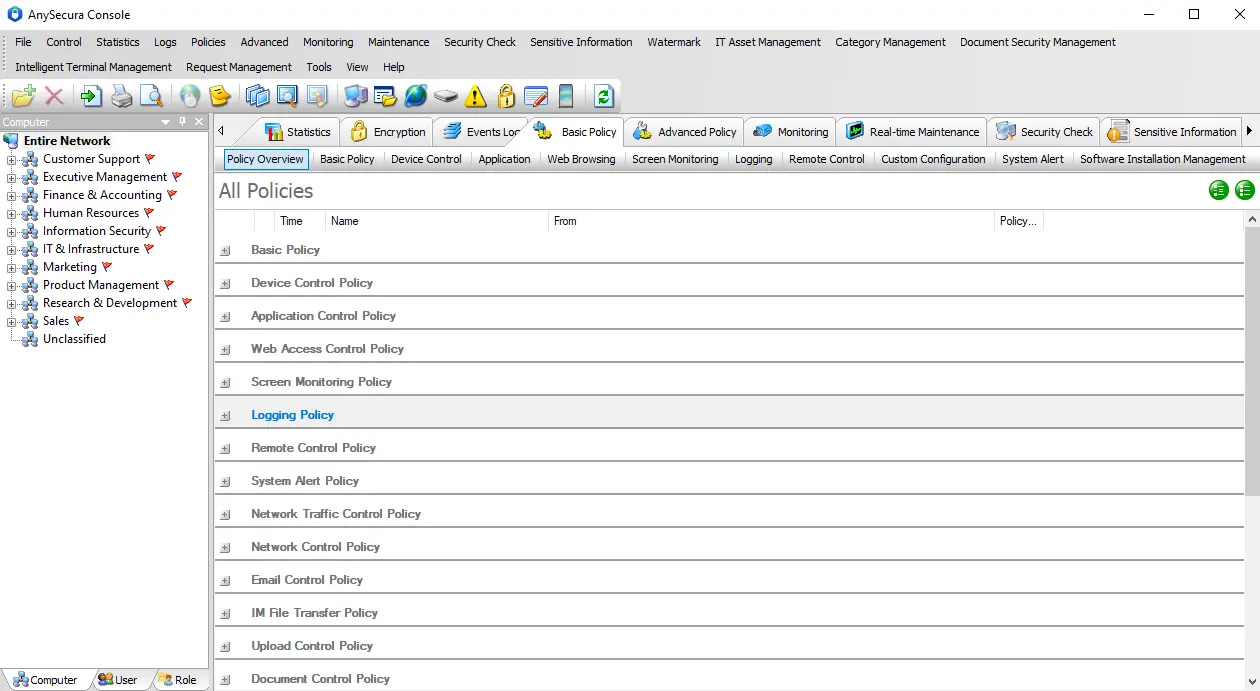
Source: AnySecura
Key features
- Transparent encryption: Files remain usable in authorized environments but cannot be normally accessed outside authorized environments
- Sensitive content inspection: Detects sensitive files based on administrator-defined rules and can trigger encryption or block external transfers
- Endpoint control: Manages USB devices, applications, printing, web access, and other potential data leakage channels
- Document protection: Supports Document Tagging, Watermarking, and Document Tracing
Why Consider AnySecura?
If your team feels that Symantec DLP can identify potential data leakage but does not give you enough control over how data is actually used, AnySecura is worth considering.
For example, if sensitive files are opened by unauthorized applications or copied to external channels, AnySecura brings encryption, access control, and application control into the same platform. This can reduce the need to purchase separate encryption or access management tools.
It is particularly suitable for organizations with primarily Windows-based environments that want to combine data loss prevention and endpoint control into a single project.
Why Not Consider AnySecura?
AnySecura is focused on endpoint management, data loss prevention, policy enforcement, and employee activity monitoring rather than replacing a traditional EDR platform. Organizations looking for malware detection, threat hunting, and broader endpoint detection and response capabilities would still need to use AnySecura alongside an antivirus or EDR solution. AnySecura itself describes the platform as working alongside antivirus or EDR tools rather than replacing them.
3. Proofpoint Enterprise DLP
Proofpoint Enterprise DLP focuses on email, endpoint, and cloud data protection.
One of Proofpoint's key differentiators is its people-centric approach. It brings email DLP, cloud security, and endpoint DLP together, allowing security teams to understand user activity and data movement across multiple channels.
Instead of looking at a single data transfer event in isolation, the platform can provide visibility into how files are created, modified, shared, and transferred across different environments.
Proofpoint is a strong option for organizations that want to connect email data protection with endpoint and cloud DLP.
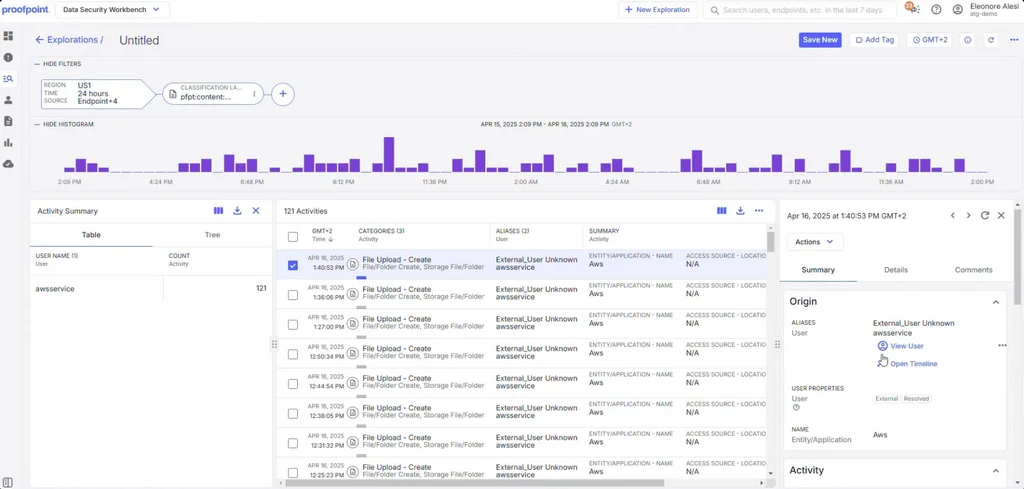
Source: Proofpoint Enterprise DLP
Key features
- Email DLP built on Proofpoint's email security capabilities
- Cross-channel visibility into user and file activity
- Cloud security capabilities covering major SaaS applications
Why Consider Proofpoint?
If a large portion of your data leakage risk comes from email or cloud file sharing rather than physical devices such as USB drives, Proofpoint's approach may be a better fit.
By connecting email, cloud, and endpoint activity, it can give security teams a broader view of how data moves across the organization rather than treating every transfer as a separate event.
For organizations already using Proofpoint's email security products, expanding into DLP can also be more straightforward.
Why Not Consider Proofpoint Enterprise DLP?
Proofpoint Enterprise DLP uses a cloud-native architecture, with Endpoint DLP hosted on the Proofpoint Information and Cloud Security Platform. Organizations that specifically require a fully self-hosted DLP deployment may therefore need to consider other options.
4. CrowdStrike Falcon Data Protection
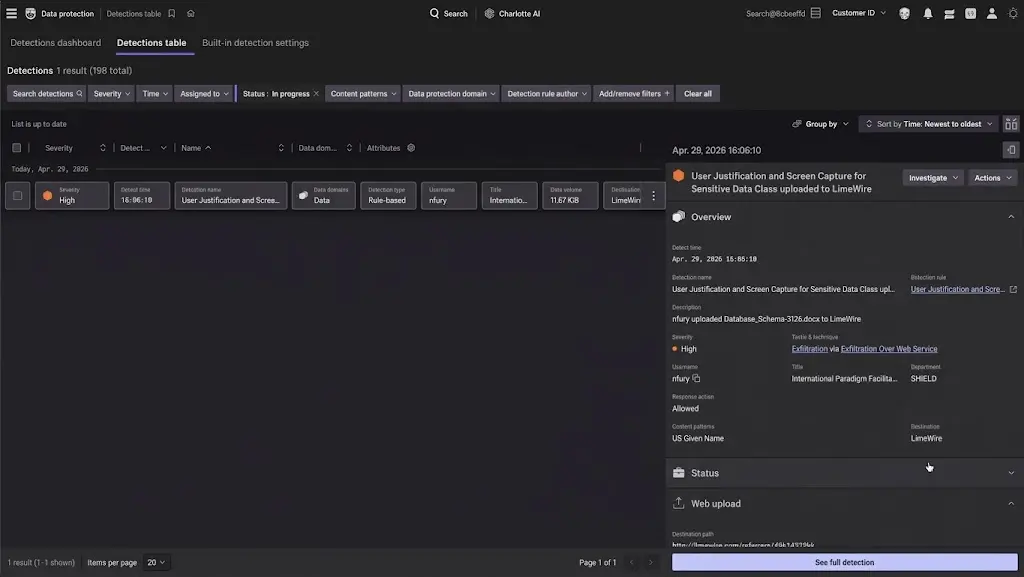
CrowdStrike Falcon Data Protection combines endpoint security with data protection.
Its capabilities include a classification engine that can identify sensitive data based on content patterns, file types, and Microsoft sensitivity labels. It also supports similarity detection, which can help track files even after they have been copied, renamed, or converted into another format.
Policies can then trigger alerts, blocking, or isolation based on data classification and user risk.
Rather than being deployed as a completely separate DLP product, these capabilities run as part of the Falcon platform and can leverage the existing Falcon Sensor.
For organizations already using CrowdStrike, this approach can reduce the complexity of managing multiple security tools and provide endpoint-level visibility into how data is moved and used.
Key features
- Classification engine based on content patterns, file types, and Microsoft sensitivity labels
- Similarity detection that can continue to identify related data after copying, renaming, or format conversion
- Data protection capabilities that can leverage the existing Falcon Sensor without requiring a separate DLP agent
Why Consider CrowdStrike Falcon Data Protection?
If you already use CrowdStrike, Falcon Data Protection can extend data protection through the existing Falcon platform and sensor, without requiring a separate DLP agent or additional endpoint infrastructure. This can simplify deployment and management for organizations already using Falcon.
Why Not Consider CrowdStrike Falcon Data Protection?
Falcon Data Protection is part of the broader CrowdStrike Falcon platform and is licensed as a Falcon subscription offering. Organizations evaluating it as a standalone DLP replacement should therefore consider the broader Falcon platform and licensing requirements as part of the deployment.
5. GTB Technologies DLP
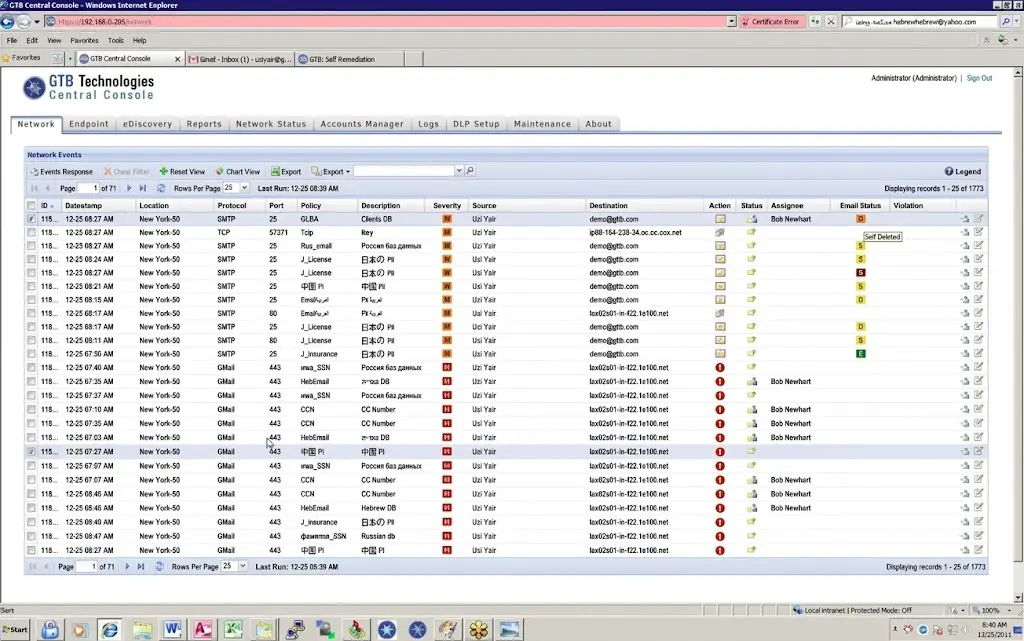
GTB Technologies DLP is a data loss prevention solution focused on protecting sensitive information across multiple data channels, including endpoints, email, web traffic, and removable media.
Its main strength is the ability to inspect and control sensitive data as it moves through different channels instead of focusing only on a single endpoint or transfer method.
Source: GTB Technologies DLP
Key features
- Binary-level content inspection across endpoints, email, web, and removable media
- Independent vendor with a product roadmap that is not tied to a larger parent company's acquisition strategy
- Supports data inspection and protection when endpoints are offline
Why Consider GTB Technologies DLP?
If your organization needs consistent inspection and control across endpoints, email, web, and removable media, GTB Technologies is worth considering.
Its offline data protection capabilities may also be useful for organizations with a large number of employees who work remotely, travel frequently, or operate outside the corporate network.
Why Not Consider GTB Technologies DLP?
GTB Technologies supports broad data protection across endpoints, networks, and cloud environments, but organizations with legacy endpoint environments should check platform support carefully. GTB's current support information states that 32-bit versions of Windows are no longer supported. Businesses that still operate legacy 32-bit Windows systems may therefore need to upgrade those endpoints or use another solution for those devices.
6. Fortra DLP
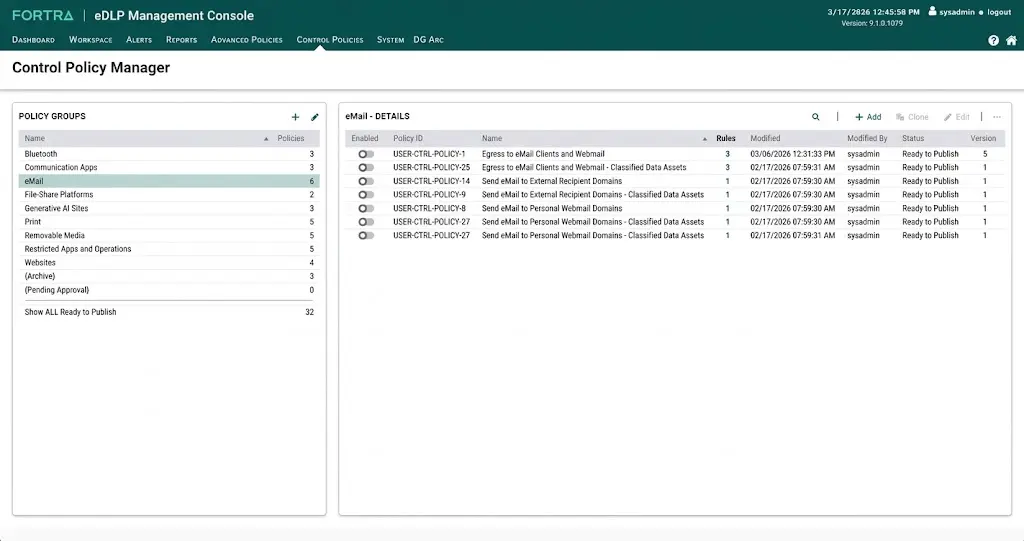
Fortra DLP, formerly Digital Guardian, is designed for organizations that need to protect sensitive data and control how that data is used and transferred.
After Digital Guardian was acquired by Fortra, it became part of Fortra's broader data security portfolio and can work with Fortra data classification products such as Boldon James and Titus.
One of its key characteristics is automated data classification. Rather than requiring organizations to spend weeks preparing classification rules before deployment, Digital Guardian emphasizes automatic classification after installation, including the identification and labeling of data such as PII, PCI, and PHI.
The platform supports on-premises deployment, cloud-hosted services, and hybrid environments, giving organizations more flexibility in how much infrastructure they want to manage themselves.
Source: Fortra DLP
Key features
- Automated classification that can identify and label PII, PCI, and PHI data
- Integration with Fortra's data classification ecosystem, including Boldon James and Titus
- Supports on-premises, cloud-hosted, and hybrid deployment models
Why Consider Fortra DLP?
Fortra is a good option for organizations looking for mature enterprise DLP capabilities and fine-grained data protection policies.
For businesses reassessing a traditional DLP platform, Fortra provides another enterprise-level alternative worth evaluating.
Why Not Consider Fortra DLP?
Fortra DLP offers broad enterprise data protection capabilities, but organizations with mobile DLP requirements should note that Digital Guardian has limited native mobile DLP capabilities and may require third-party MDM/EMM solutions.
7. Trend Micro DLP
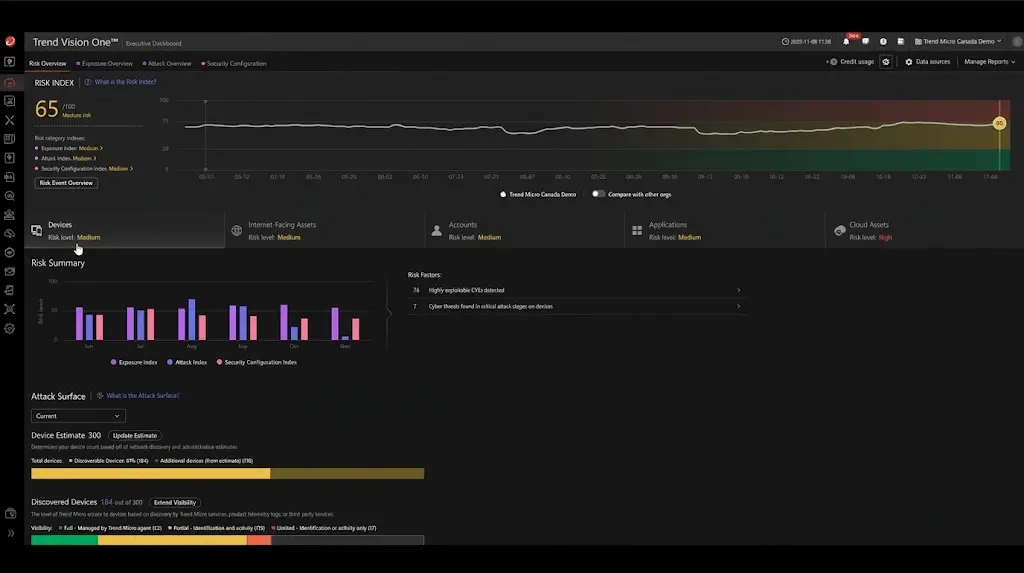
Trend Micro's data loss prevention capabilities are integrated into its broader enterprise security portfolio and Trend Vision One platform rather than being positioned solely as a standalone DLP product.
Its main advantage is integration with endpoint, email, cloud, and XDR security capabilities. This allows security teams to connect DLP events with other security alerts and investigate them in a broader context.
Trend Micro describes its DLP capabilities as integrated DLP, where data protection is provided as part of its existing security solutions.
Source: Trend Micro DLP
Key features
- Can leverage Trend Micro's existing endpoint, threat detection, and cloud security capabilities
- DLP alerts can be analyzed alongside endpoint threats and cloud security events
- Integrated into a broader XDR and cloud security platform rather than positioned as a standalone DLP product
Why Consider Trend Micro DLP?
If your security team already uses Trend Micro for endpoint and cloud security, adding a separate DLP platform could mean another console and another set of alerts to manage.
Trend Micro DLP can bring data loss events and other security events into the same analysis context, helping reduce tool switching and duplicated investigation work.
Why Not Consider Trend Micro DLP?
Trend Micro's data protection capabilities are tied to its broader Trend Vision One platform and specific endpoint agents. Some data security features also require additional credits, so organizations should check the required components and licensing before deployment.
8. ManageEngine Endpoint DLP Plus
ManageEngine Endpoint DLP Plus focuses primarily on endpoint data protection.
Its capabilities include USB and peripheral device control, clipboard restrictions, print watermarking, and trusted printer and application allowlists. It also supports multiple detection methods, including fingerprinting, regular expressions, and keywords.
Endpoint DLP Plus is part of the broader ManageEngine endpoint management portfolio. For small and mid-sized businesses already using other ManageEngine products, this can make integration and deployment easier.
Its scope is also relatively clear. The product focuses on endpoint protection. Organizations that need more advanced network or cloud DLP capabilities may need additional tools.
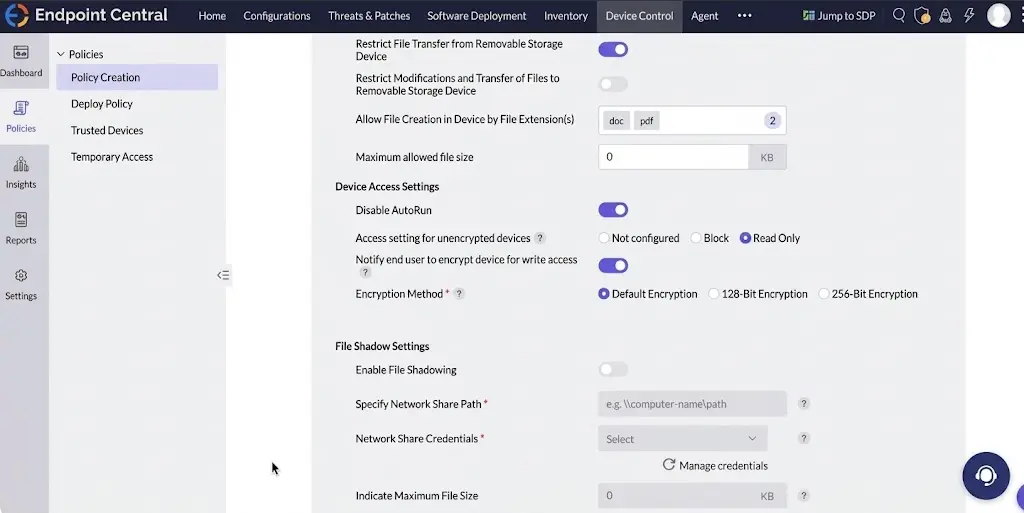
Source: ManageEngine Endpoint DLP Plus
Key features
- USB and peripheral control, clipboard restrictions, print watermarking, and trusted application and printer allowlists
- Multiple sensitive data detection methods, including fingerprinting, regular expressions, and keywords
- Part of the ManageEngine endpoint management portfolio and can work with other ManageEngine products
Why Consider ManageEngine Endpoint DLP Plus?
If your security team is relatively small and you do not need complex network or cloud DLP capabilities, ManageEngine can be a more focused option.
For organizations mainly concerned about employees copying files to USB drives, taking screenshots, or transferring sensitive data from endpoints, this endpoint-focused approach can provide the necessary controls without requiring a broader DLP platform.
Why Not Consider ManageEngine Endpoint DLP Plus?
Endpoint DLP Plus is primarily focused on endpoint protection and has specific Windows server and database requirements. For deployments managing more than 3,000 computers, ManageEngine recommends an additional SQL Server, which can add infrastructure requirements for larger environments.
Want a closer, head-to-head look at some of these DLP vendors? See how they compare on features, pricing, and deployment. Learn more>>
Which Symantec DLP Alternative Is Right for You?
There is no single DLP product that works for every organization. The Symantec DLP alternative depends on your data protection requirements, existing IT environment, deployment model, and available security resources.
If You Need Comprehensive Enterprise DLP
Forcepoint DLP is a strong option for large organizations that need centralized DLP policies across multiple data channels.
If You Need Endpoint DLP and Broader Endpoint Control
AnySecura is worth considering. In addition to Endpoint DLP, it provides Device Control, Removable Media Control, Print Control, Web Access Control, Screen Monitoring, and Employee Monitoring.
If Email and Cloud Data Are the Main Risks
Proofpoint Enterprise DLP is a good fit for this scenario. It focuses on Email, Endpoint, and Cloud Data Protection.
If You Want to Integrate Data Protection with Endpoint Security
CrowdStrike Falcon Data Protection is a strong option for organizations that already have an established endpoint security environment and want to add data protection capabilities.
If You Need DLP Across Multiple Data Channels
GTB Technologies DLP is worth considering, especially for organizations that need to protect data across endpoints, email, web, and removable media.
If You Need Enterprise-Level Data Protection
Fortra DLP is suitable for organizations that need fine-grained data protection policies in complex business environments.
If You Already Use Trend Micro Security Products
Trend Micro DLP may offer greater value through its integration capabilities and can reduce the management burden of maintaining a separate DLP platform.
If Your Main Focus Is Endpoint DLP
ManageEngine Endpoint DLP Plus is a suitable option for organizations focused on endpoint data protection, file transfers, and peripheral device control.
FAQ
What Is the Best Alternative to Symantec DLP?
There is no single best alternative for every organization.
Forcepoint, AnySecura, Proofpoint, CrowdStrike, GTB Technologies, Fortra, Trend Micro, and ManageEngine all have different strengths and product focuses.
If you need comprehensive enterprise DLP, Forcepoint is worth considering. If email and cloud data protection are your main priorities, Proofpoint may be a better fit. If you are more focused on Endpoint DLP, device control, and employee activity monitoring, AnySecura may be a better match.
Is Microsoft Purview an Alternative to Symantec DLP?
Yes. Microsoft Purview can be considered an alternative to Symantec DLP, especially for organizations that already rely heavily on Microsoft 365 and the broader Microsoft ecosystem.
However, Microsoft Purview has a stronger focus on the Microsoft ecosystem, data governance, and compliance. Organizations that prioritize Endpoint Control, device management, or on-premises deployment may want to consider other DLP solutions as well.
What Should I Look for in a Symantec DLP Alternative?
Organizations should consider deployment options and implementation time, detection technologies, channel coverage across endpoints, networks, email, cloud applications, and generative AI, as well as the depth of endpoint controls.
It is also important to evaluate whether the solution provides encryption and access controls in addition to monitoring, and whether it can integrate with your existing IT and security infrastructure.
Conclusion
Symantec DLP remains a mature enterprise data loss prevention solution, but data protection requirements are changing.
Deployment complexity, cost, endpoint control, cloud data risks, and the existing IT environment can all influence whether an organization decides to look for an alternative.
Ultimately, the right Symantec DLP alternative depends on what data you need to protect, how that data moves through your organization, and what your IT environment and security team can realistically support.
For organizations looking to combine Endpoint DLP, device control, document protection, and employee activity monitoring, AnySecura is another option worth considering beyond Symantec DLP.