
One of my top performers almost burned out quietly, and I didn't see it coming. - a hot post from r/Leadership
Are you, like this leader, unsure how to detect employee burnout? By the time you want to ask them why they have been so unmotivated lately, or when they submit their resignation, it seems too late.
According to a Gallup survey, 76% of employees experience burnout at least "sometimes" on the job, while 28% report feeling burned out "very often" or "always". The problem is especially pronounced among younger workers. Mental health today survey by Deloitte further proves that half of Gen Zs and 45% of millennials feel burned out because of the intensity and demands of their work.
Your employees may look great but in fact are suffering. This is why we can't ignore. In Gallup's latest State of the Global Workplace Report, global employee engagement fell to just 20%, which estimates that low engagement costs the world economy approximately $10 trillion in lost productivity, or 9% of GDP. Thus, for any business to pursue sustainable performance, practical solutions should be taken to prevent employee burnout.
Part 1: What Is Employee Burnout
Let me ask you a question. When you finish a long workday feeling extremely tired, is that employee burnout? Not really. It's more than the exhaustion after a busy week. Nor the simple stress. It's a long-term elimination from your job.
According to the World Health Organization (WHO), burnout is classified in the International Classification of Diseases (ICD-11) as an occupational phenomenon resulting from unmanaged workplace stress. WHO identifies three key dimensions of burnout:
- Energy depletion or exhaustion
- Increased mental distance from work or feelings of cynicism
- Reduced professional effectiveness
Unlike temporary work stress, burnout develops gradually and can affect an employee's motivation, engagement, and overall job performance over time. If you know what employee burnout is and how it differs from normal pressure, then you already have the first step for prevention.
Stress is a normal reaction to pressure — it often eases once a deadline passes or after a few days of rest. Burnout is what happens when that pressure never lets up and recovery never catches up. It is also not the same as clinical depression. WHO defines burnout as an occupational phenomenon, meaning the cynicism and exhaustion center on work rather than every part of life. An employee who still enjoys weekends with family but dreads Monday emails is showing a work-specific pattern — one that points toward changing how work is structured, not only toward individual coping strategies.
Part 2: What Causes Employee Burnout in Modern Workplaces
You may wonder why it seems that burnout is more rampant now than in recent years. What is happening?
In effect, employee burnout now is no longer caused by heavy workloads alone. Modern employees are expected to stay connected, responsive and productive throughout the day, even long after it ends.
Meeting Overload:
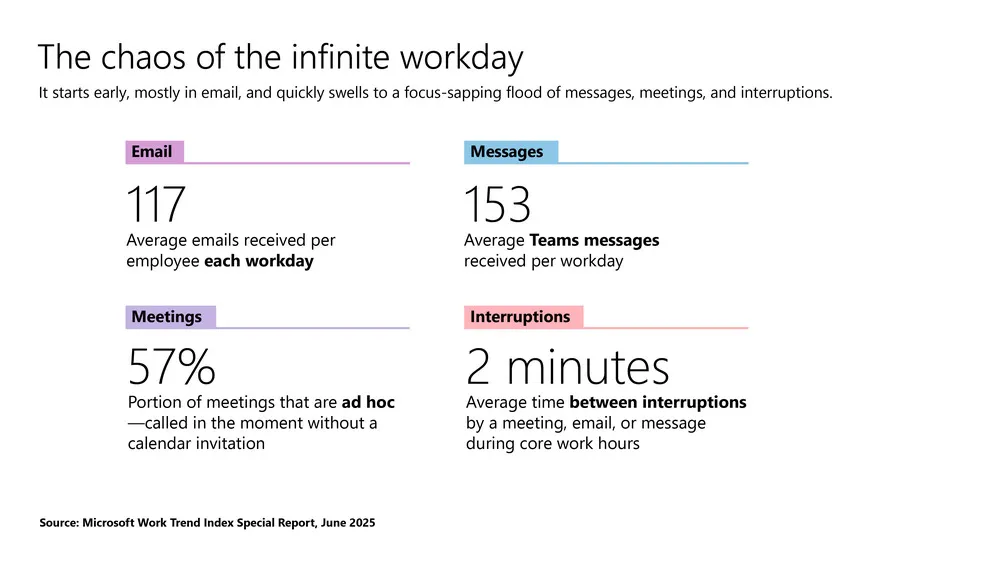
Microsoft's Work Trend Index shows that employees will be interrupted by meetings every two minutes, and worse, 60% of which are called ad hoc without any schedule. In this case, employees can't concentrate on their own work and become very passive. If they run out of energy from constant meetings, why would they be productive?
After-Hours Messaging:
The same Microsoft report also indicates that employees receive an average of 117 emails and 153 Microsoft Teams messages each day. And you might notice that one of your employees is responding to emails before sunrise, replying to messages late at night, and remaining active on weekends. You may misunderstand that they are highly engaged, but in reality, employee burnout is growing silently.
Remote Work Fatigue: (Case Analysis)
You may think that remote and hybrid work provide employees with greater flexibility, but on the other hand it brings stress. You can't communicate face-to-face, so digital tools are used more frequently. Video meetings, emails, messaging... They will feel overwhelmed by being online.
Lack of Support: (Case Analysis)
Also, employees are more likely to burn out when they feel ignored or lack guidance. Research from Deloitte has found that nearly 1/2 of employees consider a lack of support and insufficient recognition to be among the most common factors in their burnout. Even highly motivated employees can struggle when they feel they are carrying challenges alone.
Beyond these workplace patterns, Gallup identifies five experiences that correlate most strongly with burnout: unfair treatment at work, unmanageable workload, unclear communication from managers, lack of manager support, and unreasonable time pressure. Four of the five are shaped directly by how managers set priorities, communicate expectations, and advocate for their teams. Employees who strongly agree they feel supported by their manager are about 70% less likely to experience burnout regularly — which makes manager behavior one of the highest-leverage variables in prevention, not a secondary HR concern.
Part3: Real Workplace Burnout Scenarios
The more active the employee is, the less employee burnout? No. And you should know that your employees will not directly tell you like "I'm burned out". Burnout also does not look the same on everyone. Research on burnout subtypes distinguishes three common patterns: frenetic burnout from chronic overload, underchallenged burnout from boredom and stalled growth, and worn-out burnout from neglect and lack of recognition. A high performer burning out quietly is not contradicting the data — they are often showing a different subtype than the visibly overworked colleague.
Scenario 1: Growth Burnout
Employee Story: One previous employer from Reward Gateway interviewed by SHRM described feeling "trapped in a rigid role" where every day looked exactly the same. There was little opportunity to learn new skills, collaborate with others, or contribute innovative ideas. Over time, the work became repetitive and isolating, eventually leading to burnout.
Lesson for Managers: We can see that this employee is typically burned out due to a lack of support. Always the same day and the same job. She's not moaning about her excessive workload, she just feels she is no longer learning, contributing, or progressing in her career. Managers didn't give her the opportunities for skill development or internal mobility. In your teams, please ensure clear career goals for your employees and pay attention to communication.

Scenario 2: Workload Burnout
Company Story: In a question submitted to SHRM, one manager reported increasing employee complaints about stress, higher levels of sick leave, and multiple resignations over nine months. Five employees had left due to burnout, while only two new hires joined the team.
Lesson for Managers: When you finally realize the employee burnout in your company until the occurrence of the rising absenteeism and resignation, it is too late. Your employees are burned out, already. Each departure also carries a real replacement cost — SHRM puts the total cost of replacing an employee at roughly 50% to 200% of their annual salary, depending on role level, before counting the knowledge loss your remaining team absorbs. So you should track some possible warnings like work time and productivity, instead of just waiting there.

Scenario 3: Hidden Burnout
Employee Story: In a leadership discussion on Reddit, one employee shared that he had been burned out for nearly three years without management noticing. When he asked for help, they were encouraged to work harder instead. Eventually, performance improvement plans were introduced, but the underlying burnout was never addressed. He's going to resign soon.
Lesson for Managers: His managers not only missed all the early signs of his burnout, but also failed to offer any helpful support. Sometimes you may think it's the employee's low stress tolerance, and they are fine as long as they still work as usual. Actually something has changed totally. That you will lose your employees.
Scenario 4: Remote Work Burnout
Employee Story: Discussions among remote workers frequently describe that meetings consume most of the day, leaving focused work to evenings and weekends. As a result, employees remain online long after normal working hours. Life and work become ambiguous.
Lesson for Managers: Most managers can only see quick replies, online status and completed work, but fail to see longer workdays, interrupted focus time and reduced recovery periods. That makes you easily ignore employee burnout, especially for high performers. Don't think that they don't need help, they just don't say it.
Part4: Early Warning Signs of Employee Burnout
Burnout signals rarely arrive as a formal complaint. They show up as gradual shifts in behavior — and the pattern often differs by burnout subtype.
- Reduced engagement and less interest in work, even on projects they used to volunteer for.
- Regular after-hours work without corresponding output gains — a sign of fragmentation, not dedication.
- A rise in sick leave, unplanned absences, or time-off requests, especially on Mondays or after heavy project cycles.
- Slower task completion or more errors on work that used to be routine.
- Stop volunteering for projects, mentorship, or cross-team collaboration.
- Increased irritability in meetings, or withdrawal from informal team chat.
- High performers who still deliver results but stop suggesting ideas or pushing back on unrealistic deadlines — the "hidden burnout" pattern.
In your next one-on-one, try asking "what would make next month more sustainable?" rather than "how's the workload?" The first question surfaces structural problems — unclear priorities, missing support, unfair distribution — that the second often misses.
Part 5: How Managers Use Data to Prevent Employee Burnout
Now with the above early signs, you may know how to spot employee burnout. Still, you may find that it's difficult to identify in reality. To not cause any unnecessary loss to your teams, combine data tracking to find and prevent employee burnout as early as possible.
1. Time Tracking
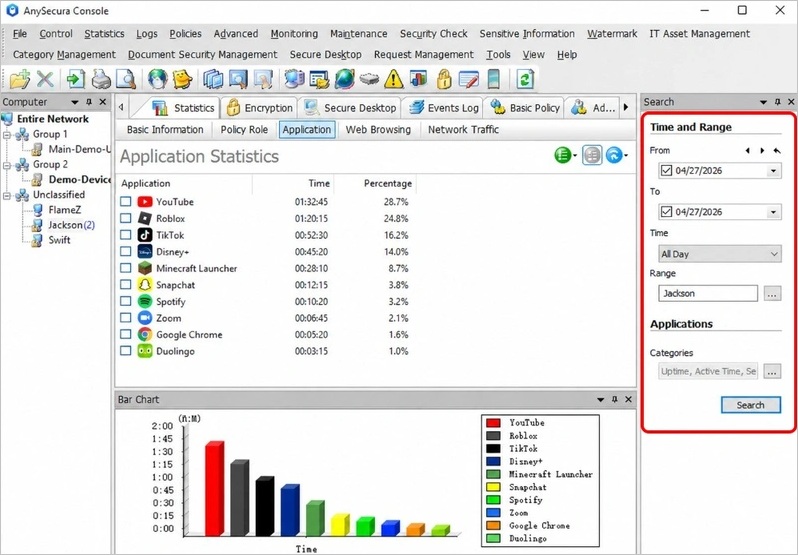
Overtime can easily lead to employee burnout. That's why time tracking and visible data matter for your company. Managers can use the all-in-one software AnySecura to track employees' computers, whether for remote teams or workplace organizations, which records the start and shut time of every employee's device. In this way, you will know who stays online late and works through lunch breaks.
It also lets you track the app or website usage to review overtime trends. How many times do they spend on working software, how long they stay on shopping or gaming websites, etc? Here you should note two kinds of employees. One is those who are overwhelmed by excessive workload, working longer hours than their peers. They may have already been exhausted and you can redistribute workloads before exhaustion affects performance. The other is those who are idling all the time, visiting irrelevant websites regularly. This means that they have already lost interest or passion for work. If you don't intervene, they will leave your team anyway.
2. Workforce Analytics
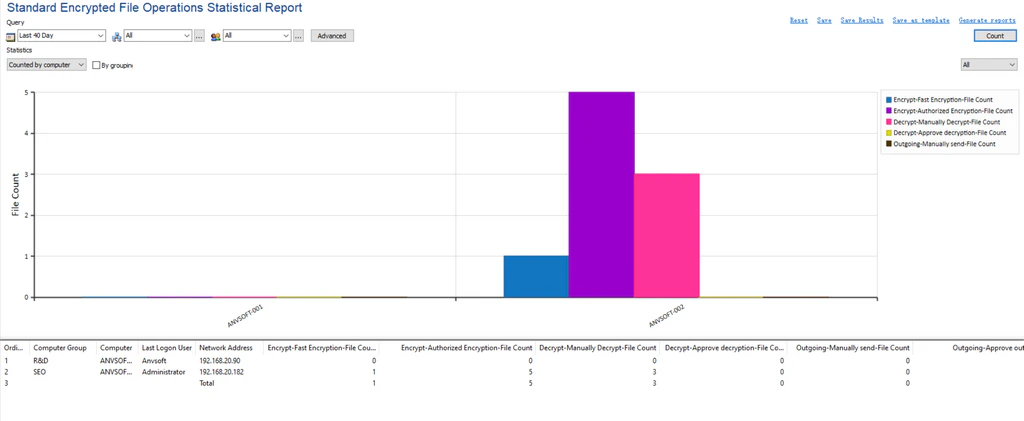
AnySecura also allows you to have workforce analytics and reveal workload patterns that are difficult to spot. Besides the apps and websites, you can get a detailed report of computer operation by each employee. You will know what they have done on their workday on this computer. Open a file, change the system settings, login attempts and more. If you find that there is any unreasonable behavior, you can take immediate action to rebalance their responsibility.
As for the file access, AnySecura records every action your employees take, including open, create, delete, edit and more. Some burned-out employees may try to transfer company data out before they leave. That's why you really should pay attention. As you can see, AnySecura can not only help prevent employee burnout, but also prevent data loss.
3. Online Activity Logging
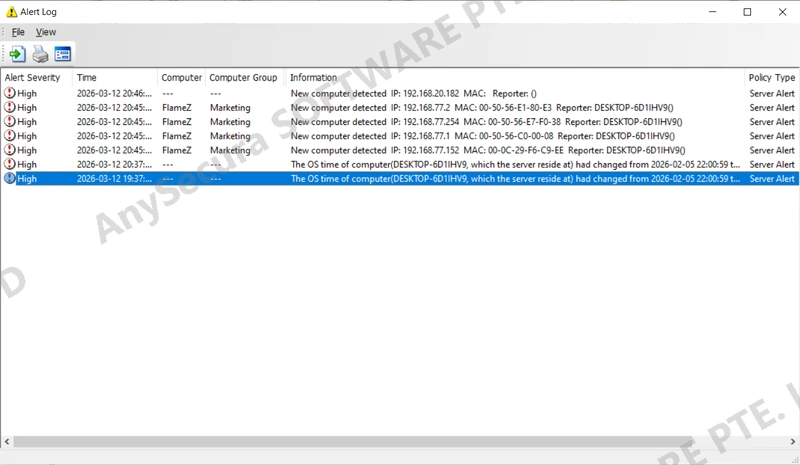
Online activity data provides you with more visibility of employees' engagement or mental health. AnySecura offers you screen logging to spot hidden employee burnout. If one employee performs well and has no suspicious signs by time tracking or workforce analytics, you can check the screen capture or recording anytime to confirm. Furthermore, AnySecura enables you to detect employees' instant messaging, including Microsoft Teams, LINE, WhatsApp and more. If they are prone to burnout, they may talk to colleagues first. And you can grab certain words or messages to spot this early. Remember to communicate with your employees kindly.
Part 6: More Pratical Ways to Prevent Employee Burnout
You may wonder other than AnySecura data tracking, are there more ways for managers to prevent employee burnout? Sure. Burnout can also cascade upward — Gallup's 2026 workplace report found manager engagement has dropped nine points since 2022, and stressed managers often pass pressure downstream. The practices below reduce that risk on both sides.
1. Ask Employees for Feedback
First, make it easy for employees to share concerns before they become serious problems. Most employees indicate that they are not willing to say this positively. Worse, when they talk, nothing happens. So as managers, regular one-on-one conversations, anonymous surveys, and team check-ins really help a lot. More importantly, listen carefully and follow up on the feedback you receive. Never treat them randomly. Employees are more likely to stay engaged when they feel their concerns are heard and taken seriously.
2. Give Employees More Control Over Their Work
That employees can not control their progress can be very depressing. You should give employees greater flexibility in how they organize and complete their tasks. Constant supervision can increase frustration and reduce motivation. Whenever possible, allow employees to prioritize their work, manage their schedules, and make decisions within their responsibilities. Gradually, you will find that a greater sense of control often leads to lower stress levels.
3. Encourage Team Collaboration and Peer Support
We believe we do not need to emphasize this again. Most employee burnout is due to isolation. Never let them handle challenges alone, for a long long time. Instead, you should encourage team members to share knowledge, ask for help, and support one another during busy periods.
4. Protect Deep Work Time
We mentioned this as well. Many employees spend large portions of their day responding to emails, messages and meetings. As a result, important work often gets pushed into evenings or weekends. Thus, learn to set aside blocks of uninterrupted time where employees can focus on meaningful tasks without constant interruptions, which helps improve productivity while reducing mental fatigue.
5. Reduce Unnecessary Meetings
Not every discussion requires a meeting. You can remove those that no longer provide value. For necessary meetings, keep agendas clear and limit attendance to relevant participants. Avoid ad hoc in particular.
6. Build Sustainable Work Schedules
Furthermore, managers should pay attention to workloads and working hours across the team. Make sure deadlines are realistic, workloads are distributed fairly, and employees have enough time to recover between demanding projects.
7. Encourage Employees to Take Time Off
Actually, those who do not take time off are more likely to have workforce burnout. Many employees delay using vacation days because they feel too busy or worry about falling behind. Managers should actively encourage time off and help employees disconnect from work while they are away.

FAQs About Prevent Employee Burnout
1. What managers can do about burnout?
Managers can reduce burnout by identifying stress early, and then balance workloads and create open communication within the team. Realistic deadlines and clear priorities help employees stay productive without becoming overwhelmed. Besides, managers should also encourage your employees to take breaks and use their vacation time when needed.
2. What is the best way to manage burnout?
Do something real. The best way to manage burnout is to address the causes rather than the symptoms. This may include reducing excessive workloads, limiting unnecessary meetings, and providing employees with more control over their work. Your consistent support is often more effective than one-time wellness initiatives.
3. Are employers responsible for employee burnout?
Not all. Burnout can have multiple causes, and no doubt that employers play an important role in preventing it.
Unrealistic expectations, overtime, poor communication, and lack of support can all increase burnout risk. Therefore, it is recommended to use AnySecura to track the data, get the clear burnout trends and improve your team competence.
4. What is the best app to monitor and prevent employee burnout?
Employee burnout is often linked to excessive workloads, overtime, and unhealthy work patterns. AnySecura can help you identify these risks through time tracking, workforce analytics, and online activity insights. By spotting workload imbalances early, you can take action before burnout affects your productivity and engagement.

Discover 13 daily work habits, focus strategies, and lightweight tools to improve efficiency at work without burning out. Learn more>>
Final Words
How to prevent employee burnout? The only key is to know your employees more. Employee burnout rarely happens overnight. By recognizing early warning signs, listening to employees, and using data to identify risks, we believe that you can take proactive steps to prevent burnout before it leads to disengagement or turnover. AnySecura provides the visibility needed to support healthier workloads, improve team wellbeing, and create a more sustainable work environment.